

Live & Immersive Walking Tour of Essaouira
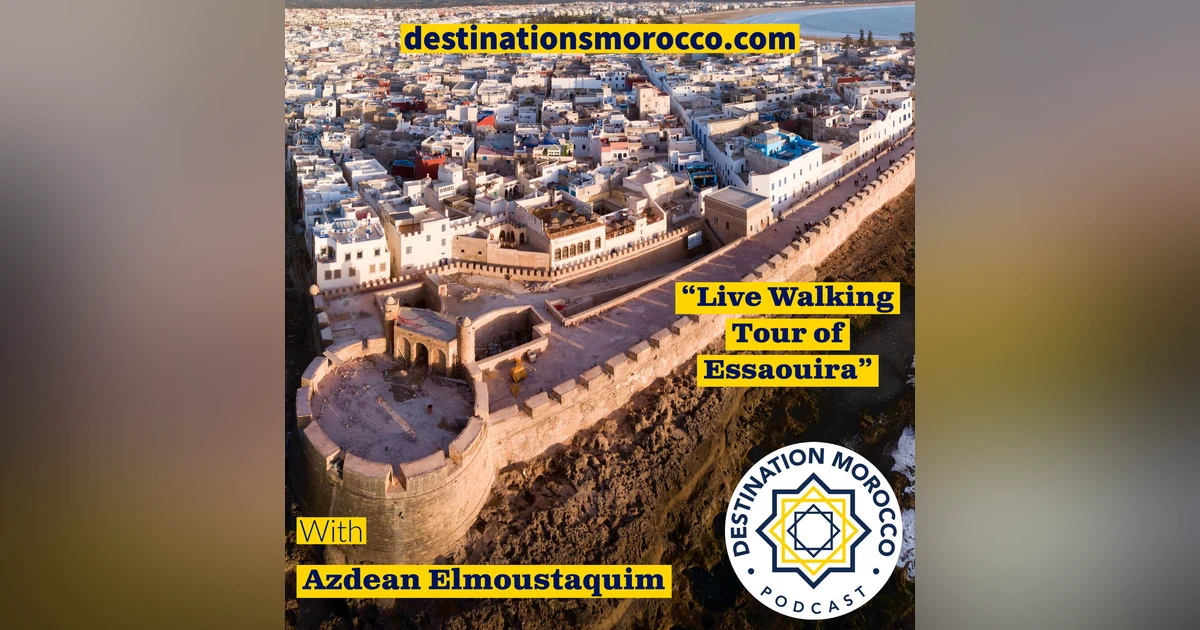


In a first for Destination Morocco, we take you along on an authentic, immersive walking tour of the beautiful coastal city of Essaouira, and a preview of more great live content to come this year.
Walk with us as we explore the Medina, the ramparts, fishing harbour and market, artisan craftworks, and learn how the pluralistic, welcoming spirit of Essaouira made it a haven for multiple religions and languages, all living side by side.
The audio is raw, authentic and captured on-site. You'll hear street music, waves crashing, seagulls hunting for scraps, footsteps down quiet alleys and traders selling their wares. It's a genuine example of the type of local tour you can expect when you go with Destination Morocco.
Podcast producer Ted Cragg and his family has the chance to visit Morocco themselves in February of this year. Ted chatted with Azdean about it on our March 15 episode, particularly from the angle of travelling in Morocco with young kids.
Essaouira was the final stop on their tour, and being a quieter, more laid-back place, it presented a perfect opportunity to do this live recording. The tour was led by a local guide, in this case Ait Bahadou Zaid, a veteran of Essaouira tours who typically escorts groups of 40-50 people at a time.
However, being a Destination Morocco tour, Ted and family had Zaid for a private tour, and you’ll hear the full range of interactive questions and personalized commentary.
As Ted explains, as a listener himself, it was the pinch-me moment he had dreamed of since learning about Essaouira in Episode 7. Of all the fabulous sights in Morocco, it was this small oceanside city with its sweeping sandy beach, moderate climate and relaxed feel that was the place he was most excited to see.
To capture its charm and spirit was the goal of this episode, and it will undoubtedly inspire you to go and discover it yourself.
Resources Mentioned in this episode:
Essaouira, Morroco
Episode Blog post with more photos of the tour.
Episode: "Discover Essaouira, Morocco's Coastal Gem"
Episode: "Family Travel in Morocco"
Destination Morocco is your ultimate travel experience for those seeking luxury and adventure. We specialize in crafting bespoke itineraries tailored to your unique tastes and desires. If you're a discerning traveler who values an immersive, curated adventure, visit www.destinationsmorocco.com, and let us bring your dream Moroccan vacation to life.
Do you dream of exploring the enchanting land of Morocco?
Destination Morocco is your ultimate travel experience for those seeking luxury and adventure. We specialize in crafting bespoke itineraries tailored to your unique tastes and desires.
If you're a discerning traveler who values an immersive, curated adventure, visit www.destinationsmorocco.com, and let us bring your dream Moroccan vacation to life.
Learn more about Azdean and Destination Morocco.
Download the stunning Destination Morocco magazine!
Follow the podcast and help us grow.
(Promo):
Do you dream of exploring the enchanted land of Morocco? Discover the magic with Destination Morocco, the ultimate travel experience for those seeking luxury and adventure. We specialize in crafting bespoke itineraries tailored to your unique tastes and desires.
If you are a discerning traveler who values an immersive, curated adventure, then visit destinationsmorocco.com. That's destinations with an S, morocco.com, and let us bring your dream Moroccan vacation to life.
AZDEAN ELMOUSTAQUIM (Opening):
Welcome to the Destination Morocco podcast, the show that takes you away to the beautiful country of Morocco. I am your host, Azdean Elmoustaquim. In each episode, we explore Moroccan culture, history, attractions, and activities: real and practical information coming from experienced travelers and native Moroccans like myself. Our goal is to help travelers that are struggling with planning any type of trip to Morocco.
Our company Destination Morocco builds personalized tour packages that will ensure you enjoy our country just like a local. Follow us at destinationsmorocco.com. And now, let's go exploring!
TED CRAGG (Intro):
Greetings, salam alaikum from Essaouira. I'm standing on this beautiful wide and deep beach looking out over the Atlantic Ocean here, right at the edge of Morocco. My name's Ted, I'm the producer of the Destination Morocco podcast, and I'm taking the microphone for this episode. Thank you very much to Azdean, and not just for this opportunity, but thank you very much Azdean for the wonderful tour that we've had here in Morocco for the past 10 days.
Myself, my wife, Emilie, and our two kids, they're seven and five years old. We've been guided around the country by Driss, who you met recently on Episode 28, and our wonderful driver, Abdurahim, aka Abdul. Today's a beautiful sunny day. A few little clouds in the sky. We've been quite fortunate with the weather our entire time here. I mean, it's been late February, so winterish weather; of course, us coming from Canada, it's a different perspective. We've had days of around 15, 18 degrees Celsius, so roughly 65, maybe 70 Fahrenheit when the sun really comes out, just tiny bits of rain and it's really, really nice to be back by the ocean.
Now you can probably hear the waves just behind me. There's lots of hustling, bustling activity, relatively speaking, along the seafront, but it's nothing compared to when we were in Fès, Marrakech and most of the other destinations that we've been, and this is partly why I really wanted to make a point of recording something for you here in Essaouira.
I'm recording into my little portable device and I didn't really feel too comfortable walking around the tight, busy medinas of Fès and Marrakesh with this expensive equipment right in front of me. So I used my phone when we were there, my iPhone, to capture some sounds in the squares and so on, and that was okay.
But this is a much higher quality, and really it's kind of the culmination of our trip. It is our last day. Tomorrow we head back to Portugal, where we've been for about a month and a half before here. We have another month after, and then we go back to Canada at the end of March. We did a great walking tour around the old part of Essaouira, along the waterfront through the old Medina, the fort that's there - the battlements - with Zaid, who is a wonderful tour guide.
So you're going to hear his tour here in a few minutes. I did have my device out as we walked around on his tour through the Medina, and I've put together some of the highlights of his tour. You'll hear us as we're there live on site.
Before the tour, we had lunch at Riad Zahra, and we met Xavier, the host. You'll remember him from our early episode about a year ago on Essaouira. So this coming up, this episode here, it's our second profile of the city, but now you have the walking tour. I think Essaouira has been a highlight though for me because when we put together that episode with Xavier, I'd never heard of Essaouira. Of course, I'm just like you, the listeners. I've been learning about Morocco this whole time, and when he was describing this beachfront town with a different kind of laid back feel and his beautiful riad, and then I saw some pictures, and you can even go to his website. There's a webcam. You can see the beach, you can see people kitesurfing live right in front of you on your computer.
So when we did that episode and I discovered Essaouira, that was a moment. I was like, I really do need to get to Morocco. I wanna see this place. So when we got here earlier today on a day trip from Marrakech, it's about a two and a half hour drive from Marrakech over here to the coast. And to stand here looking out over the beach, this place I've dreamed of coming to, this is why we travel to see these places in person in real life, to turn a dream into reality. It was kind of a pinch-me moment when we were actually here. We made it all the way to Morocco, all the way to Essaouira, and it's as beautiful as the pictures and the stories told.
So I'm gonna transition now to our walking tour that we just did today with Zaid. Come along with us as we walk through the narrow alleys, the streets, and the waterfront ramparts of Essaouira.
TED:
So now we're walking towards the port, is that where we're going?
ZAID:
Yeah. Yes. We are going to start by the port. Okay. To show you the blue boats, if you want to take some photo. Mm-hmm. And you can smell Chanel no. Fish (laughs).
TED (Interlude):
We started off by the port of Essaouira, a sheltered, rectangular shaped harbor with a narrow opening to the sea, protected by a breakwater parallel to the ocean. The harbor is full of small wooden fishing boats painted blue, which often show up in photos and postcards. When you look at Essaouira from overhead via Google Maps, for example, you'll see the long beach curving around the bay, and at the north end of that beach is a point like a fish hook poking out into the Atlantic, separating the beach from the open ocean.
This is where we were standing. The tour would encompass the historic Medina of Essaouira, which is roughly diamond shaped, and fills out the approach to the point and port. Like any Medina in Morocco, it's a tangle of narrow alleyways and low structures, hundreds of years old. Just beyond the Medina, the modern city spreads out in a more grid-like fashion, but we would only drive quickly through this part later on our way out of town. There was more than enough to see over the course of a two hour tour just keeping to the Medina and following along the city walls. Zaid began by explaining a bit of the history and development of Essaouira and how it became one of the foremost ports in Northwest Africa in the 18th century, long before modern Casablanca and Tangier, and overcoming competition from Agadir to the south.
ZAID:
Essaouira was Morocco's primary commercial port and window onto the world until the mid 1800s. Agadir is around 180 kilometers south, but the inhabitants of Agadir didn't pay taxes for the king. For one reason, the capital was controlled by the Spanish. The king cut off trading for Agadir and opened the one.
The second reason, the Capital was in Marrakech, so the king needed the closest possible port, which from Marrakech to is around five days walking with camels. So like this, in the beginning we call it the half of Marrakech, because they had one connection only with Marrakesh.
The second name: The Harbor of Timbuktu, do you know Timbuktu? Yeah. In Mali. Why? Most of the products that we use in trading, we bring them from the desert, like feathers, lighters, almond, gold. Mm-hmm. It was the best harbor in Africa and the city was like a big African market till 1844. When the French Army bombs its port. From this year the city lost its status as the best harbor in Africa. Do you understand?
TED:
Yeah. Yeah, I do.
ZAID:
If not, I speak Berber with you (laughs). Just kidding.
So this is a fleet of fishing boats. They're just kind of little runabouts. They're wooden boats. I have to say, well, maybe 12, 15 feet long, about four feet wide. There's kind of three or four little benches that go across the boat. So people have a place to sit, but they're open boats and they're, we're kind of in a bit of a sheltered harbor here with like concrete walls, a little bit inland from the open ocean, and they're tied up about five in a row.
TED (Interlude):
So I’m counting 5, 10, 15, 20, plus 40. This has gotta be 50 or 60 of these boats here. And this looks to be the Essaouira fishing fleet. The time right now is about three o'clock in the afternoon. They seem to be cleaning and kind of organizing their stuff. Lots and lots of seagulls flying around. You might hear those in the background.
TED:
Do the fishing boats go out pretty early in the morning?
ZAID:
Not exactly. Why? For one reason, because most of the time it's windy. You know, the best time for fishing is in the night. There's a lot of fish. But most of the time it's windy. So the night is very dangerous. It's dark and it's windy. So they have just short time for fishing.
Oh, and this is a fish market. Okay? I will show you in. We have two fish markets. This one, and I will show the main one inside. This is very important for one reason. I mean, when they finish fishing, they try to send it very quickly to go to the house. So the fish is fresh and the price is very good. So you can, for example, if you want to get in the restaurant, there's one near the wharf, which means you can buy your fish here and have it cleaned and you bring it to the restaurant.
Easy. Easy for the client.
TED (Interlude):
We then moved from the outdoor fish market outside the city walls and into the Medina itself. To get into the Medina from the port, you pass through the “Gates of Tolerance,” or the Bab El Marsa, built in 1770. Zaid explains how the stone sculptures above the arch in the gate are not just a random decoration, but deeply symbolic of Essaouira’s history for parity and religious tolerance. Christians, Muslims, and Jews are all represented on the gate, and therefore, welcome in the city to live and trade together.
ZAID:
So this is the gate of the harbor, the Gate of Tolerance. In the top, you see the shell of San Jacobov compost. In Spain, there is one city called Santiago De Compost. There's a per image for the Christians. This is the symbol for the Christians. On the left, you can see there is a flower simple for the set. But in the second flower in the middle, Star of David for the Jewish. Why? One time in Essaouira we had many people who were Jewish. More than 12,000 Jewish, 41 synagogues. Today, three Jewish synagogues. In the middle there is three MO, as for Islam. Why three MO? As a reference for Mohammad II, the founder of the city.
TED (Interlude):
We head through the gate, following along the inside of the wall, which parallels the ocean shore. We're heading for the kasbah and the Place Moulay Hassan, the main square of the Medina, which Game of Thrones fans will recognize from season three. The Square used to feature another gate where merchants would enter and pay their taxes.
Place Moulay Hassan is also a focal point for the Gnawa African and World Music Festival, one of the world's largest annual music festivals, which takes place each June and welcomes up to 500,000 people over four days.
ZAID:
And this place is very famous for shooting lots of movies, like Game of Thrones three. Asta for Del, when he bought 8,000 soldiers to make them free, it was in this place. It's film right here.
TED:
Wow. So this is the main square?
ZAID:
Mm-hmm. That we call Moulay Hassan Square. It was the garden for the King. Now very famous by Gnawa music African music.
TED:
That's the music festival, isn't it?
ZAID:
Yes. The last week of June.
So our visit, it will be in the medina. As you know, the media is downtown. And the medina, we have seven areas, each area has nine, and each area there is five by six elements. The mosque, the fountain, the kasbah, the Religion School, and Hamman. So we start our visits by the kasbah. This is the kasbah. It was the richest area. It was for the king. The big Jewish and Christian merchants and for the councilors. Before we had a mill gate here, the name of this gate is Bab Laachour. Lachoour is taxes. The merchants must stop here.
TED (Interlude):
We're heading down a fairly dark alleyway here with fairly low, arch ceilings. I mean, I don't have to bend over, which I've done a lot in Morocco, but here it is maybe eight feet high, but yeah, it's a fairly narrow alley. It's quite dark. There's some light down towards the end and some little kiosks along the way.
Some nice cotton clothing here on display, some rugs and carpets, and as you can probably tell within a few seconds here, it gets quite quiet. Tranquil of breath of fresh air, even from the fairly calm open space of Essaouira, the main road itself. We continued walking down the quiet alleyway away from the hustle and bustle, clearly in a more residential area. Zaid points out a riad that we would not have otherwise noticed. He gives a great explanation of the design principles of a riad, designed for both Muslim customs and for the climate of Morocco.
ZAID:
So this is a riad. A riad means a house with a garden, always in the riad. In the middle there is a fountain and four gardens. The original riad never had windows outside. If you have seen windows outside it is a fake one. I will show you the original doors are very short, very small, for four reasons. The house keeps the same temperature. For the safety, all the houses from outside are safe. With that, you can walk. You can't see what's happening inside. Oh, and respect your mother. Before the doors have been smaller. You lock the gates or open for your mother, you must dial down. Respect your mother means inside she is your mom.
TED (Interlude):
We head back out to a more open area towards a prominent rampart. The round defensive tower of the city wall that is the northwestern point of the Medina, kind of the outermost point of that diamond shape. There's a long wide stone ramp that parallels the wall slowly rising to the round tower.
Underneath the wall are a number of garage-like cubby holes where artisans sell their wares. The tower is lined with cannons pointing out to sea from within the round platform.
ZAID:
This is the best part. See the nice view special for the sunset? Okay. We're climbing up quite a bit here. This is nice. It's kind of like a round tower, huh? So the name of this place is Las Scale. Its Italian name is “stairs.” There are two scale, scale of Nina and the scale of the harbor. Before, the city was like a big African market. All African products ended here. Many different European powers tried to conquer it. In order to defend, it was the cannons that spin right inside. There is one big circle in the middle and when we speak there is echo. Why? Because when we use the cannons, they make a huge noise to scare the enemies.
TED (Interlude):
It's like a circular platform. Stone platform, roughly a hundred feet wide. There's two big cannons here right now. There's openings for more, but you can imagine when the cannons fired and they recoil and the boom that would happen here within these stone walls.
ZAID:
This comes from Barcelona, in 1780. This is the crown, the Spanish crown, and we have the letters of Carlos. We have C, we have the A, we have the R, L O, and S Carlos ii.
TED:
So who would've built this tower here?
ZAID:
This complex?
TED:
The complex.
ZAID:
It was from Genova, Italians. It was Italian. It was Italians like this. You have this name? Scala?
TED:
Yeah.
ZAID:
Italian. Okay. We start built Essaouira in 1760, and we finish the kasbah in 12 years. And after we start in the part of the city. But the influence is European, French and Italians. Because as you know, this time, especially in Europe, there is a lot of war. So we need some engineers to build the fortress very strong. Soldiers, we bring them too, so it’s built like in France or in Spain, it's not Moroccan if you want.
TED:
Yeah. That's interesting. You don't hear about the Italians too much. Did they have an impact on Morocco besides in Essaouira?
ZAID:
It's only Essaouira. The other cities, no, I don't think so. But as I told you, in this time, in the beginning of 18th century, the city was like the African economic capital. So we had Italian, Portuguese, Spanish. Each one helps with their experience.
TED
Yeah, we learned about the pirates, n Rabat mostly, I think.
ZAID:
Yeah.
TED:
Were they here too?
ZAID:
No. Why did they choose Rabat? Because it's close to Spain. And their dream is to make a big empire. One day maybe they will compare to Spain or Portuguese.
TED:
So they basically stayed around what’s now Rabat instead of coming down here.
ZAID:
Yeah. Yeah. So if you want to take this way, come on, we can go down. Watch your head for the second door.
TED (Interlude):
There's a little opening here at the edge of the round courtyard. It's about five feet high. Oh yeah. And narrow stairs. And this is gonna take us out of the tower. “Watch your head daddy!”. Well, it's less than five feet now. “I made it!”
ZAID:
So we have been in the kasbah, do you know what it means, kasbah?
TED:
It's a fortress, castle.
ZAID:
Many, many, no. A number of things. We start to make it easy. One minute. Okay. Kasbah means bamboo. The cane. Do you know the flute?
TED:
Yeah
ZAID:
We call it in Morocco “kasba.”
TED:
Oh, I didn't know that.
ZAID:
If you ask some other Arabic citizens what means “kasba,” it means “bamboo.” And Kaba is a big house or fortress area. But why we call it kasbah? Because as you know, most of the time it's dryness in the desert. So if you have the bamboo, it's easy to build a house. Sometimes you can build the wall, but if there is no bamboo, see there is no roof. But dry, you can say your house is kasbah. Even if you are living in small floor, it means you are generous. Why? Because when the Muslims from Africa or south of Morocco, on the way to the pilgrimage. As you know, there are no hotels in the way. Where did they sleep? It's with the family. So it means your gate or your door is always open like this. When you have a lot of strangers come home, you say your house is “kasbah,” you are generous.
Okay, this is the market. This way, please.
TED (Interlude):
Leaving the walled ramparts, we head back into the residential heart of the Medina, and Zaid points out the different types of homes and who would've built them and lived there.
ZAID:
How do we know? Even today, just like above the Gate of Tolerance that we walked through earlier, there are stone carvings over the doorways of many houses here, identifying the religion of those who live there, their profession, or sometimes both. As you have seen in the harbor, the flower symbol for the city, the Santiago de Compost means the house was for the Christians.
I will show some houses with David Stars, for the Jewish. Some houses with horseshoes, means the owner of the family was a blacksmith. Some with wheat flour. Make bread as a baker. Crab: Fishman. Flower: herbs. I will show you many other, and this means the symbol for tolerance. You can show your religion, and you are saved.
TED
And these are all carved in stone over the doorways.
ZAID:
Yes. The symbols. Yeah, yeah. And here you can see the shell of Santiago de Compost. It means it's a Fishman and Christian.
TED:
Okay. There's the horseshoe means, uh, blacksmith, right?
ZAID:
Yes. Blacksmith. You pass the test.
TED:
The baker.
ZAID:
Baker, good! Show you the flower, herbalist. Okay, it says spices. And here can see the Jewish David Star for the Jewish. And the flower is always symbol for the city.
And this is the house of Orson Welles.
TED:
Oh really?
ZAID:
It was the Orson Welles house, yes. He was here in 1951 for shooting the movie Othello. That's very famous for Morocco because he wins the Golden Palme in Cannes, in France. It was a gift from Morocco.
TED:
That's cool.
TED (Interlude):
Orson Welles directed and starred in the movie Othello here in Essaouira in 1951 and lived off and on in the city for many months. The film has since become one of the city's claims to fame and the lanes and streets of the Medina feature prominently in many scenes. There's even a park here between the Place Moulay Hassan and the beach called Place Orson Welles, where you'll find a glowering bas-relief sculpture of the man himself.
We are on our way to the main indoor fish market and then the wood carvers and other artisan studios. To get there, we walked through the Jewish quarter or Mellah. Of course, in such tight quarters and in a city so tolerant and integrated, you'll easily find signs of Jewish, Christian, and Muslim culture right next to each other.
Zaid paused to explain to us not just the meaning of the word Mellah, a term native to Morocco, but also how the Muslim call to prayer that we've heard throughout Morocco over the past nine days has a particular twist here in Essaouira.
ZAID:
Okay. And now we are in the Mellah, do you know what it means, Mellah?
TED:
This is the Jewish quarter?
ZAID:
Yeah. And why do we call it Mellah? The name, it comes from “mallah,” which means salt. The Jewish word for salt. So I show you the mosque without tower respects for the Jewish rabbi, to the mosque without tower. As you know, we call five times a day. The first one is always one hour before sunrise, the second today, for example, at two o'clock, but I will show you there's one mosque at half past three, the third at five o'clock, but the same mosque half past five.
Four, in sunset for all the mosque. The last one hour and a half after sunset. Why in the day we have two times, or two Mosques? Because this is the business area. If you come to pray at two o'clock, you have the second chance. It's half past three.
TED:
I see.
ZAID:
Yeah, because in Islam, if you come to the mosque and you pray with the group, you have 27 good deeds. If you pray alone, even in the mosque, You have 10. Means, if I have no time, like in the mosque, in the group, maybe I can pray in my shop with another person. It is the same like the mosque 27. When you hear the call to prayer, you have 10 minutes and they will start praying.
TED:
I was wondering about that. How much time do you have to get there?
ZAID:
10 minutes.
TED:
So you're saying the mosque here was built without a minaret?
ZAID:
I will show you. There are three here in this area. Okay, so this is the mosque and it's still working. Still used no tower, the neighbors were Jewish. It's like a provocation. It's not polite that the Jewish open the windows, and in front of the windows there is a tower of the mosque. It's impolite, so this is how it works.
TED (Interlude):
We turn a corner and encounter a large building with chipped plaster coating on its walls and a mustard yellow color painted around the doors, windows, and corners. The door itself is a rich, dark blue, a small faded sign hanging over the door. Hand-painted in Arabic and French, it is written “Hamam.”
ZAID:
This is Hamam. Okay, come on. Here we have a sign. This is Hamam. Why hamam? Before, no water in houses. If you want to take a shower,, you must come here. Now, we have shower at home, but we still come into the hamam for two reasons. For the massage and sauna, we have warm water, but no heater. Second reason: in Islam, when you have human pleasure, you are impure. It's forbidden to pray. Even at home, it's forbidden. To enter to the mosque, you must take shower. The first prayer is very early in the morning. Today, for example, seven o'clock. In summer, half past three. Really means if you want to go to the mosque in the summer, around half past three means you must take shower before that. Three o'clock is very early. If you take your shower at home at three o'clock, everybody knows the reason! You take your towel, come to the hamam, mosque, come back home. No one sees, no one hears!
TED (Interlude):
We passed by the Hamam. There wasn't much to see. It was an open door with a bag of concrete dust at the entrance. So we couldn't really see inside. And of course, that's the whole point, it's quite a sacred space. It's a private space and it's hard to really get a sense of what's in there unless you have the chance to go in.
Throughout Morocco as you walk through a Medina, if you look down at the street, which is typically made from slabs of stone or cobblestones, there will often be a double line of inlaid stone bricks running down the middle, following the same direction as the street. You wouldn't think anything of it unless you are informed of what it means, and you wouldn't be the only one either.
ZAID:
Do you know what ot means, two stones like this?
TED:
Well, something about if it's like the main street, two is there.
ZAID:
Bigger street. It's more of a main street.
TED:
Yeah.
ZAID:
When there is no two stones, means dead end.
TED:
Oh yeah.
ZAID:
Okay. When there are stones, it means in the end, there is some exit. That most of the time they don't respect because,
TED:
…nice idea.
ZAID:
Yeah. Even the person who made this, if you ask him what it means, he doesn't understand why. Oh, okay. Look at the balcony. The small size and the balcony.
TED:
Yeah.
ZAID:
This that you see is the Lorraine Cross, you know or not?
TED:
No.
ZAID:
Come on here. And you see the balcony in small size. The Lorraine Cross. It's very famous in France. As you know, in the Second World War, there is the government of Vichy. This is the symbol for the resistance against Hitler, against the Nazis - means when the French come to settle here in Essaouira, they trust the family who lives inside, because they have the symbol. In French you say “Croix de Lorraine.”
TED (Interlude):
We were staring up at these narrow balconies on the first floor above street level with railings made of wood and with peeling turquoise blue paint. It was hard to make out the Cross of Lorraine at first, but I was looking in the wrong place. It would never be over the top of a window or any place prominent and obvious, not while Morocco was controlled by Vichy France during the years 1940 to 1942.
At the ends of the railing where it turned 90 degrees on each end to enclose the balcony, instead of the square patterns of the front with an X through them. It was a vertical post crossed twice by a small horizontal bar, just a few inches wide on each side. I.e. not crossing the entire width of the space. Although a bit out of proportion, these could easily be identified as Croix de Lorraine, if you knew what you were looking for. Yet could also be passed off as just some generic design. You'll find my picture of it in the blog article that goes with this episode.
We reach at last, the big indoor fish market bustling with merchants and customers. The indoor market occupies a central place in the Medina, right smack in the middle, at the junction of the two main wide streets. It was a place more for sounds and smells than explanations, so we just took in the ambience.
From there, we head south towards the fabulous Thuya Wood carvers co-op. Our final stop before heading back to Driss and Abdul at the van.
TED:
“Shrimp. It's a whole pile of shrimp. That's a lot of fish.”
ZAID:
In 1770, when the Moroccan king Mohammed III cut off trade from Agadir, they forced the merchants to come to settle here, because they have a lot of experience in trading and they speak many different languages.
TED:
Do people here live mostly off tourism?
ZAID:
Tourism, fish, and artisans. The minimum wage is $200 USD, 2000 Dirham, per month.
TED:
So in terms of crafts, is Essaouira mostly known for the wood carving?
ZAID:
Yes. That I will show you. The carving is famous here in Essaouira. There is thuya wood, like Juniper Wood, and silver and painting.
TED:
Okay.
ZAID
The city for the artists.
TED:
Ah we're getting into the wood design.
ZAID:
Yeah.
TED (Interlude):
We head down a narrow but bright laneway to find the thuya wood carvers co-op, where we are greeted by a host who gives us a quick tour of how they put the pieces together. They use different types of wood and mother of pearl, glued together to create intricate designs for everything from little jewelry boxes to dining room tables, chairs, lamps, chest sets, backgammon, and so much more.
TED:
This is a cooperative?
GUIDE:
Yes. A cooperative, yes. So our speciality is thuya wood. It is a Juniper. So we use the root, we cut it to small slices and we colle (glue) it together. You see here. So this is piece by piece, colled together. And there is another technique which is inlay. So we use the track and we inly that with different motif like that.
TED (Interlude):
On our way out from the co-op, the sidewalks widened and the space opened up as we left the Medina and headed back towards the van parked alongside the beach. I had the chance to get a bit of Zaid's backstory, and for what his days are like.
ZAID:
Now it's high season. We start at nine o'clock to midday, every day. Each midday, I have a big groups. Between 40 to 80 persons, and three languages.
TED (Interlude):
Zaid in fact comes from Merzouga, across the Atlas Mountains, in the same general region as Driss and Abdul and Azdean, and so many others that we've met and gotten to know through this podcast.
Finding good, trustworthy local people to escort tourist visitors safely is just as important for them as it is for us who are visiting the country for the first time.
Ted:
Are you from Essaouira then?
ZAID:
No, I’m from Merzouga. 500 kilometers from here, and now it's my hometown. Like this, we trust between us, whether Driss or - we come from the same area, then now if you work with us it is like a safe hand.
TED:
Sure.
ZAID:
So as you have seen, We don't push people, I mean for shopping or, well, anyway, you know, we go to the wood cooperative, for example, or the jewelry.
TED:
Yes, well the work speaks for itself. If it's something you're interested in, you're gonna buy something.
ZAID:
Mm-hmm.
TED (Interlude):
We say our thanks, and if you recognize his voice, you'll hear Driss from Episode 28 make a cameo as we get back into the van for the drive back to Marrakech.
ZAID:
Oh, I hope you enjoyed it!
TED:
It's been wonderful.
ZAID
Thank you a lot Ted.
TED:
Yeah!
DRISS:
This is my best buddy here in Essaouira.
ZAID:
Thank you a lot Ted! Have a good day!
TED:
Cheers. Thank you so much.
TED (Conclusion):
You may be wondering how much you can really see and understand of a city or location when you only have a day or even a half day to visit. A tour with a local guide allows you to uncover so much in a short time that you would never discover otherwise. You move on feeling like you have a good base of knowledge for the place, perhaps a foundation to then come back and explore more in the future.
But at the very least, when you're back home, weeks and months later, you can look back and feel like “We saw it, we get it.” Not to mention it's the best and often only way to really interact with locals, from the guide themselves to the people they know, who you wouldn't have the chance to meet otherwise. On our trip, we had local guides in Fès, Volubilis, Meknes, Rabat, and in Marrakech, as well as with Zaid in Essaouira, and it made all the difference.
You get the best of both worlds. The overall consistent presence of your tour director, Driss in our case, but then the expertise and efficiency of the local guide. With Destination Morocco, you get licensed reliable guides who have years of experience, who you won't have to find yourself and wonder if they are trustworthy and legitimate.
It eliminates that stress and anxiety, and it's worth every penny. Or Dirham. If you like what you hear and want to experience it too, reach out to Destination Morocco to learn more about their tours and options. It's truly the best way to see Morocco. It's organized and thorough. You feel safe and you get the most out of the country, especially in a short period of time.
Destinationsmorocco.com. That's Destinations with an S, is the brand new website with lots more information. You can also find the blog and past episodes from the podcast.
Thanks for listening in. I'm excited to put together more immersive experiences like this when Azdean heads back to Morocco himself this summer. He'll capture more sights, sounds and stories himself. Today's episode is a great prelude for that. It was a wonderful opportunity and I hope you enjoyed it and we'll see you next time.
AZDEAN (Outro):
Thanks for joining us this week on the Destination Morocco Podcast, our dedicated show website. Destinationmoroccopodcast.com is where you can find all of our episodes. Leave a review, find our social media links, and even register as a guest. If you have been to Morocco yourself and would love to share a story, advice, or recommendations, you're welcome to participate in our podcast. Whether it's a five minute story or full conversation, we will guide you through the steps so that you can share your experience with our listeners.
We will be back soon enough with a new episode for you as we continue our exploration of the beautiful country of Morocco. See you then.