


 Apple Podcasts
 Amazon Music
 Castro
 Spotify
 RSS Feed
 iHeartRadio
 Staying Warm, Staying Comfortable in Morocco
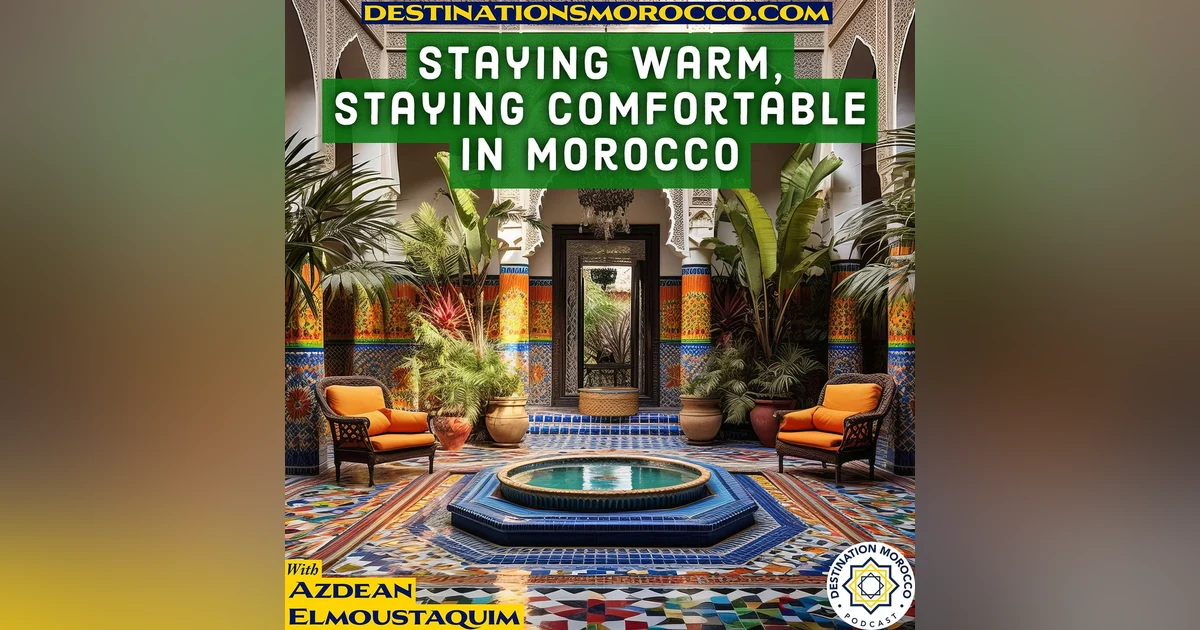

You can also watch the video version of this episode on our YouTube channel here: "Staying Warm, Staying Comfortable in Morocco" --- A destination like Morocco is instantly one that inspires adventure, excitement and discovery. Pushing your comfort zone and experiencing something new and different. But it's one thing to try some new food or sleep in a luxury tent in the desert, it's another to have not known to bring warm enough clothes, or to be stuck climbing multiple flights of stai...
You can also watch the video version of this episode on our YouTube channel here:
"Staying Warm, Staying Comfortable in Morocco"
---
A destination like Morocco is instantly one that inspires adventure, excitement and discovery. Pushing your comfort zone and experiencing something new and different.
But it's one thing to try some new food or sleep in a luxury tent in the desert, it's another to have not known to bring warm enough clothes, or to be stuck climbing multiple flights of stairs in your riad, because you didn't know they don't have elevators...
Our conversation today addresses lots of practical tips for travellers, with questions like clothing and accessibility in mind.
A lot of it comes down to the type of trip you are on: a solo or independent adventure, a private or small group tour, or a large group tour. Large being more than about 25 people. You don't want to go on a large tour.
Azdean is joined by producer Ted to look at the unique challenges of winter travel, including accommodation heating issues, cultural differences, and mobility considerations.
We always recommend staying in riads if at all possible, but the reality is, 99% are not designed with accessibility in mind. Most are at least 4 or 5 floors, with stairs the only access. You can research and request a room on the ground floor, if one exists, but you might ultimately need to consider a hotel or a more modern accommodation, depending on your needs.
However, riads are still open for visits and meals, so make every effort to check out at least a couple. And in turn, don't forget that your hotel needs to be in a suitable location as well, easy to access, and in a quiet neighborhood, not next to the clubs!
We encourage you to try new things and be open to new experiences while you're in Morocco, there's nothing else like it. Today's episode just helps you become a little more familiar, and thus a little more comfortable, with the adventure that awaits.
Join me for an 8-Day Boutique Moroccan Experience!
Step inside the hidden Morocco on this first-of-its-kind, 12-spot journey, hosted personally by Azdean.
November 8-15, 2026, $1995 USD Per Person
Book Your Spot Today!
Learn more about Azdean and Destination Morocco.
[00:00:00]
AZDEAN ELMOUSTAQUIM: Welcome back to another amazing episode of Destination Morocco podcast. In today's episode, we have Ted, our producer. He's gonna have a really, really, really interesting topic that we're gonna be discussing and a lot of questions to answer to. So Ted, welcome back to the podcast.
TED CRAGG: Yeah, I've been popping in quite a bit lately. It's fun though. I love it. It's great to talk about travel. It's wonderful to talk about Morocco and, um, you know, I, I mean, I'm not trying to be the co-host or anything here regularly, but it's, it is fun to pop in from time to time and I think it helps with some of the, some of the flow of our episodes that, you know, there's someone who can ask you the questions, right?
You're the expert and, and, uh, it just, it creates a bit of a different ambiance. So yeah, it's fun. Always fun to be here. so what we wanna talk about today is, uh, really focused on something that's more broad. It's not so much time sensitive, and it's about how to choose. The [00:01:00] best group tour. The group tour that's right for you.
Uh, and really don't travel or don't choose a group tour before listening to this episode because we're gonna give you some good perspective here. I mean, you hear a lot about different options and what to think about, um, but how do you really get to making that right decision for you? And that's all in the context too, of.
Destination, Morocco. I mean, there's, they're small group tours. They can be private tours if it's just a couple, traveling, you know, but generally the smallish group tours maybe six people or 12 people or something like that. We're certainly not talking about the big massive group tours of 40, 50 people on a big coach.
And you're hustled from here to there and you hardly get to know your guide and you're just kind of go, go, go. It's nothing like that. This is very much relaxed and casual and fun, and it's. The with itineraries, of course, that are made to your liking. It's your choice. You get to choose what you wanna do, as far as the itinerary goes.
So that's the context of the tours that we're talking about as far as group tours go. Um, [00:02:00] and yeah, you know, Destination Morocco has been doing this for years of course, and so you guys have learned a lot of things about. How to make that choice based on what people's interests and needs are. So, a big impetus for this is the fact that, you know, as we're talking right now, it's, uh, you're in Marrakesh and it's, it is cold and you know, if people are watching this in February, when this comes out, at least here in, in North America and stuff, it's winter.
What's the temperature like right now? There over in Marakesh.
AZDEAN ELMOUSTAQUIM: The temperature? Well, I would say it's, uh, probably around 10 Celsius.
TED CRAGG: Mm-hmm.
AZDEAN ELMOUSTAQUIM: Yeah, average 10 cell Cs, it gets warm around, you know, midday. but then again around four 30, 5:00 PM the temperature starts to drop again. And also depending where you live, some areas you have access to the sun, which is good. In some apartment buildings or areas, you don't have that luxury, so it feels a little bit more cold.
TED CRAGG: Right. So 10 Celsius, that's about 50 Fahrenheit. [00:03:00] and yeah. Now I know you're kind of getting into like maybe late afternoon or the evening, like if you're, well, here's a question then. I mean, this isn't quite related to our topic, but I am curious. So when, when it's the winter in Marrakesh, does the square still come alive as it usually does?
Right. Gem Square, is it just as busy as always?
AZDEAN ELMOUSTAQUIM: Yes it does. Um, it's always the same thing. Um, and also keep in mind the food in the square changes from summer to winter. Uh. Wintertime, there's a little bit more the delicacies that we eat, certain type of food that we eat, which keeps us warming if you would. Um, you know, like beans, lentil, uh, and many other things.
So it is different and, uh, the, the square is always packed, is always busy in the winter time. It start, I would say around four o'clock, probably four 30, you'll see the setup, the tents, the stalls, uh, the merchants, you know, the, the snake [00:04:00] charmers, the, the monkey players, the, the Hana, uh, scam at food artists.
So it's, it all comes to life, uh, and it stays that way for, you know, the next 10 to 11 hours. Yeah,
TED CRAGG: Yeah. So therefore if you're talking, it's January, February and stuff in the middle of winter, the square may be bustling at like 10 o'clock at night. What's the temperature like then?
Usually
AZDEAN ELMOUSTAQUIM: the temperature, I would say probably five degrees. And again, it depends what city marque. It's maybe five, six, Celsius?
TED CRAGG: Yeah, about 40 Fahrenheit. Yeah.
AZDEAN ELMOUSTAQUIM: Yes.
TED CRAGG: Okay. But it can get colder
than.
AZDEAN ELMOUSTAQUIM: it does sometimes it does. Yes. Especially early mornings, not much. The night when it's busy and inspecting the square, you're not gonna really, really feel it unless you're walking outside the crowd.
Then you'll feel it's a little bit colder than, than it was earlier. Yeah,
TED CRAGG: Mm-hmm. is it a dry cold or is it a damp
cold?
AZDEAN ELMOUSTAQUIM: it is a dry cold in
Marques. You know, in Marrakech. because we are. [00:05:00] In between mountains, and you can see in the backdrop, you'll see the, for example, uh, Oden, uh, mountain, which is really popular ski place, especially during the winter time. it's really, really nice. So that's where we get the cold, during the, the winter time in Marrakech.
TED CRAGG: so this all comes back to choosing the tours and, and as much when you go, because obviously certain times of year, different types of temperature, it could be really hot in the summer, could certainly be very cold in the winter. Um, and how does that impact the tours? Because particularly with, let's say accommodation and how to accommodations, are they able to.
incorporate, you know, the heating and stuff that's required.
AZDEAN ELMOUSTAQUIM: That's a really good question, Ted. I've been in Morocco during the, the summertime. and I've been in Morocco, well, uh, last year, which is was around January, uh, February, and it was a lot colder than what it is right now. Now we are in, in, in December, almost mid-December, and it's still cold. So [00:06:00] one of the biggest differences that I have noticed last time I didn't travel, I was just, I stayed in Marrakech.
So, um, you know, the, the, the pattern, the weather pattern was really predictable. every day it's really, really cold, that it gets warm, that it gets a little bit hot, then it gets cold again. So I was perfectly fine with that, and adjusting was just perfect. Then the place where I was staying, it has a heater.
So, and the heater in the US is little different than Morocco. In the US everything is centralized and, you know, uh. If it's your house, it gets warm at the same time. Here in Morocco, it's like spots, you know, one spot can feel really, really hot and another spot can feel really, uh, not as hot. So, and that's the thing that I really noticed this time traveling, um, you know, from city to city, the north side of Morocco, the southern part of Morocco.
So it does make a difference and you really need to, to do in a way, kind of your homework or at least know what you are getting into because you may not, Think that you're gonna get [00:07:00] the best hiter or things like you may be disappointed in, in, in, in short. So,
TED CRAGG: Well, I guess in other words, we can't assume that, uh, at least all accommodations, even the nice riads, but you know, if they're not really designed for that kind of winter, and they don't have the central heating, so you're talking like the little space, portable space heaters, maybe that kind of heat a little area around them.
Right? But they're not gonna heat a whole room, especially with big high ceilings and stuff like
that.
AZDEAN ELMOUSTAQUIM: That's right. They have portable, small portable heaters. They have some units, uh, which have, I've seen since we were kids. They're kind of, you know, a part of a wall if you would. Uh, and it, it gets the, the, the, the temperature really, really high. But the room, again, the area next to the wall may feel hot, but.
And then the further you get from the wall, uh, the, the colder it's gonna be in way and also that unit to just install it inside the room. And, you know, then it pumps heat if you would, into, into the room. So if the [00:08:00] room is big, it may not as be as powerful as you would, uh, for the room to be, uh, feeling very comfortable for you to sleep in.
Now the other thing that I noticed, Ted. You know, the summertime, which is hot. The AC feels good. There's no issue in the ac you know, you, you just, you know, you, you, you adjust it 18 celsius, 18 degrees Celsius, I'm not sure the equivalent to Fahrenheit, and it feels really comfortable. And nice. And you can sleep in, not an issue.
But during the winter time, one of the challenges and things that I have noticed, there's a cultural difference. People in Morocco, they don't like to use heaters. They say, Hey, we get sick. Hey, you know, we, it's hot. We go outside, cold and hot and, and and so forth. So in the us uh, using the heater, it's, it's very common.
It's, it's a must if, if, if you would. So here is different and then the setup is different. what I noticed when I, when I was in Casablanca, when I was in fast, when I was in all the other cities, I could not, [00:09:00] you know, go above 30 degree Celsius. Um,
TED CRAGG: Okay.
AZDEAN ELMOUSTAQUIM: so the max that I could hit my, my, my, my room, if you would, is 30 degrees Celsius.
The equivalent to that is, uh.
TED CRAGG: Well, it was about Mid eighties Fahrenheit.
AZDEAN ELMOUSTAQUIM: eighties, so mid eighties Fahrenheit, which, you know, by US standard or North America standard, that's pretty hot. Um, I would not wanna set up my house or my room to 86 degrees because I wouldn't be able to breathe. But then in Morocco it really feels like, you know, it's maybe 72.
TED CRAGG: Fahrenheit.
AZDEAN ELMOUSTAQUIM: Fahrenheit. Yes, that's right. So it doesn't really feel that hot. You feel the warmth, but not really the heat. So, this can be a challenge, uh, for some of the people for
TED CRAGG: Yeah. So that comes back to efficiency then that what you may set the heater to is not necessarily what you're gonna end up
getting.
AZDEAN ELMOUSTAQUIM: that's right. That is corrected.
Yes. Yeah,
TED CRAGG: What about [00:10:00] common spaces, especially in a riad, where people go to eat and, and all that? Are they any better? Or is, is it even harder to heat? Maybe it's bigger
space.
AZDEAN ELMOUSTAQUIM: it's, it's a bigger space. Uh, it's a really good question. By the way, Ted, it is a bigger space, and this is one of the reasons why, what, what I have noticed, uh, when it's a restaurant, when it's a bigger space, they have multiple units installed. So they kind of, you can still feel, hey, it is warm, it is comfortable, warm, but then again, your room is different because that's where you're gonna sleep.
but the restaurants that did not really witness that challenge, uh, there were multiple hitters and it was, it was good. It was functioning just fine.
TED CRAGG: Okay. Hmm. And then there's camps because you certainly still want to go to places like Merzouga and Agafay and you know, give people the chance to sleep in the camps. They're open year round. What do they do for heating? Um, especially, yes, like these canvas tents.
AZDEAN ELMOUSTAQUIM: well, I think couple of them have, the air condition. A couple of them have the heaters, but I would say 95% of them, they tend to [00:11:00] stay away from it because of the danger that it can, that it can cause. Um, I know, uh, when incidents, at a camp, uh, the heater caught fire. Um, so it, it's, it's not good. So most of them will not have the heaters, but what they do have is the isolation.
You know, in the tent. So when you go inside and it's hot outside, it feels really cool. But then when it's cold outside, then you go inside, it feels really warm. Uh, so that's, it's really nice. But then again, you really have to do your homework. The, the, the type of, you know, camp you're gonna be staying, because that can be a challenge.
So when you go with us, we, we do the work for you, but then if you do it on your own, you might run into some challenges.
TED CRAGG: Right. So this it, I mean, these are the, these are the challenges, but um. What are the solutions then, you know, if people do want to travel to Morocco in the winter, I mean, and choose a group tour and so on. Corresponding part of the thing with a group tour, as you [00:12:00] say, is, I mean, if it's a private tour, it's one thing, maybe if it's a small group tour of say six people like you, you wanna be able to accommodate everyone for sure.
And, and their needs, whether it's dietary or health or anything else. So, you know, you, you have to be very conscious of that. what are the solutions then that people can look for to make the
best choice?
AZDEAN ELMOUSTAQUIM: I would say one of them in this case, Just have a little bit extra layers of clothes with you, extra blanket, uh, because people, it doesn't matter, even with that cold, they still wanna feel it, they still want to experience it and just have a little bit of, you know, extra blanket, warm blanket, and also put in, you know, extra layers of clothes if you would.
So, for me, that's what I did. Um, it was really, really cold and uh, I had two blankets. Uh, I think in the middle of the night I tried to move and I moved left, and it's so cold. Then I moved back to the right and it just stayed that way until I woke up. But it was a lot of fun, so it was amazing.
TED CRAGG: Well, that's fine. I mean, to be fair, it, it is [00:13:00] part of the adventure of travel. I mean, you know, you're outta your comfort zone. That's kind of the point. You know, we're, we're experiencing different countries and different, uh, cultures and landscapes to a point. I mean, we don't wanna be too uncomfortable and, and to the point of not enjoying the experience,
that's kind of the
limit,
right?
AZDEAN ELMOUSTAQUIM: Absolutely. You said it really, really correct. If I may add something else that, because you said, you said it's cultural experience and this, this, this is really, really deep. The reason is, if you wanna go on vacation, this is not your typical vacation. This is an immersive experience, a cultural experience, and it has the good and the bad.
But at the end. You come up with tons and tons of unforgettable memories. Uh, yes. It's, my experience was cold and I loved it. It was fun at the end. You know, we talk about it, we laugh about it, but it just, I didn't expect. To get rid of that cold, especially my, my perception of heaters and the hate in the US versus Morocco.
So, but I know because I, I, you [00:14:00] know, I go back and forth and that could relate to, to both cultures. But I would like to share this, not in terms of talking negative, but in terms of you alignment, in terms of sharing information because I don't want you to be disappointed and, and I want you to know what to expect and, and be really.
Ready for it, and at the same time, immerse yourself in that experience and, and truly, truly enjoy, the local culture as well. So,
TED CRAGG: Yeah, that's why we wanted to do this, this topic here, this episode is, is, uh, you know, not trying to shy away from things. It's just addressing that, um, this, these are the realities. And what's hard is when people don't expect it and they're caught off guard and well, I didn't think it'd be that cold and they didn't come prepared.
Now there's only so much you wanna pack. I would say too, I mean, it's very important to have layers, but I mean. The riads, the camps, will they provide blankets? Will they do anything else to, you know, help accommodate that comfort? 'cause a lot of these, these buildings and the camps, they're, they're not all [00:15:00] that well insulated.
They're not really designed for that. Of course, they're dealing with the summer too, and the other extreme. But, you know, are, they prepared to accommodate, of course, the tourists that are coming from different parts of the world that have those expectations and may not have listened to
this episode and
be
prepared.
AZDEAN ELMOUSTAQUIM: Oh, a hundred percent. Yes, they do. They do have, you know, the extra blanket that you, you're gonna need extra food. Whatever you need. They, they, they have it for you. You know, I, I just wanna, you know, just give more information because, personally, I've traveled back and forth and back and forth, but this is the first time that I travel in December in those areas.
Um, in first you're good in major cities, in good, but then when you go to, you know, to a village, when you go to the desert, when you go to the mountains, they gonna be some challenges and we just wanna prepare you for them just at least know about them. So that way you don't feel, you know, disappointed or like that said, missing out on the experience.
They are part of the experience. So,
TED CRAGG: Yeah. Well, that's a good point that you were, you were saying a bit earlier when we started, like it's one thing if you're staying in Marrakesh or Fez, wherever, that's [00:16:00] your trip and. Number one, you should have bit more warmer accommodation and they're prepared for that. And number two, you're stable.
You kind of get used to it. You're in one place, you can do what you need. But when you're moving around all the time and you're going to places that are a little more rustic, isolated out in the mountains, course, mountains have their whole other weather, weather patterns and uh, temperature and so on. So, you know, again, that's the whole point we're here is to explore and discover.
But that means your environment's gonna change. So. Just being prepared is what really matters. Now the other thing we wanna talk about, actually no, there's one last thing I wanna bring up that said that you guys, when it comes to choosing the accommodation for people, I mean it's part of the benefit of going with the tour company.
You've got your contacts, you know what to look for, you know what to ask for, like for instance. There's a hotel, let's say Casablanca is a good example and you know, to look for hotels that aren't in the clubbing district, right? Where, where there, there's club music booming till five in the morning. And I mean, that might not be so obvious to other people.
They don't [00:17:00] think to ask that, but you know where to look for those things. Or when there's a tents in the desert, you were telling me how you know, you can find where there are specific positions that maybe get a little more sun and that they have certain, certain angles, right? And that can make a huge difference.
AZDEAN ELMOUSTAQUIM: Of course, it definitely does. You're absolutely right. Um, you know, Ted, because again, when you have a group of people, you want them to be comfortable. It doesn't matter what accommodation it is, but. You know, especially in the big cities, especially on the weekends, especially because the clubs in, in Morocco, they tend to stay up open, if you would, until five in the morning.
And, and you don't want to be feel like you're part of that club. So we, we make sure that they put you somewhere that is kind of nice and quiet and so forth. the same thing with, with the, with the, the position of the camp, if you would, in, in the desert. when you have a group of people and you want them to feel, the local experience you want them to feel the Moroccan experience, the Moroccan House experience.
The riad [00:18:00] experience, if you would, riads in Morocco are not created equal. in some cities, like in Casablanca, there's none. But then you have fast you. Dades Valley. You have, for example, Merzouga. You have Marrakesh riads. They're all different. and none of them, or most of them, probably 99.9% of them do not have elevators.
So when you wanna compare a group of people and you say, Hey, I want them to stay at our yards so they can feel that immersive experience, that local experience, and so forth, that's really, really good. But then you have to keep in consideration. The age of the group that is traveling with you. If it's, you know, uh, anybody, I would say the fifties or less without any, you know, um, mobility issues, they'll be just fine.
But then if you have, you know, people with the mobility, uh, issues, then you're making their experience a little bit more difficult. So. Yeah,
TED CRAGG: Yeah. And that's the other thing we wanted to talk about, broadly speaking with [00:19:00] this, uh, this topic here today was mobility as far as choosing tours and, and knowing maybe the right questions to ask, so. I mean, what do, what can you do to kind of solve that challenge in terms of, um, accommodating
people's
mobility
needs?
AZDEAN ELMOUSTAQUIM: that's a really good question. You can do two things. the first one is communication, communicate. if you are part of the group and you are, you're the one in charge for that group. Communicate the details of the mobility issues, whether they somebody has them or somebody doesn't have them. Uh, because with the group, we absolutely recommend a hotels versus the riads with the small, you know, probably 2 0 2.
For six, even eight people, we still would recommend, uh, stay in riads. But then when we have a large group, it's absolutely better to stay at a hotel for many reasons. Because when someone not from Morocco, they think of riads and, and a hotel. [00:20:00] They think the hotel is similar to the riad in a way, including, oh, they're gonna have elevators.
So they automatically assume that a riad would have. An elevator, especially when you're talking about two story, three story or four story house. So in a lot of those cases there's none. So you have to go, you know, up down those stairs. And again, in certain regards, the steps are close to each other, which makes it a little bit easier to move.
But then in someones that, you know, the, the space between a step and the step next to it is really steep. So it's very difficult, you know, especially have 20. 30. and it can be very challenging. So those are one of the questions that I would highly recommend because it's gonna make a huge difference on your tour.
Just say, Hey, we are a group of people. We wanna stay out, and chances are it's gonna be very difficult. So I, I highly recommend the hotels instead.
TED CRAGG: [00:21:00] Yeah. Yeah. It's the, I guess by nature of being more modern, they're gonna have more of the modern facilities. It's a shame that they don't all do, but you know, as part of the, the riads, is their heritage properties like a hundred years old or more? Can you find many, are there many options? Maybe. It depends where you look that.
you can at least reserve a room on a ground floor, you know, or maybe riyadh's that
aren't quite as
tall.
AZDEAN ELMOUSTAQUIM: That's a good one. But I, I just wanna explain to the audience when you're in Morocco and they tell you, we have you on the first floor, that's actually the second level.
TED CRAGG: Yes,
AZDEAN ELMOUSTAQUIM: So
TED CRAGG: I've
experienced
that,
AZDEAN ELMOUSTAQUIM: I, I told you they're tricksters, you
TED CRAGG: not just in Morocco. That's, that's a European thing too, I think. Right?
Like the first floor is actually what we would call the second floor.
AZDEAN ELMOUSTAQUIM: Exactly. Yes. The first floor you'll see the front desk, you'll see the receptionist, you'll see we'll have breakfast, lunch, probably buffet and stuff like that.
So, and uh, what they refer to as the first floor is our second [00:22:00] floor. So Thes just.
There's no, I would say just consider all of them with no elevators. The second thing is, Choose the riad that it's closer to the street. You know, you'll get dropped off. You'll walk right into your, versus walking like a maze of streets and you'll get lost along the way. And sometimes you have a hot air balloon and the transportation company's gonna come and pick you up, and they may not be able to leave their car by itself and come and get you.
So it can be a little bit challenging. So, um, if you stay in a riad, just make sure that the riad Is not in the middle of downtown the Medina, it's not in the other side of the Medina. So it's, you just have to, to choose wisely. And again, if you're doing, if you're coming with us, we make those decisions for you.
We help you with those choices and we select certain riads and present them to you and see if they're good fit for you or you know, we need to, to change, maybe upgrade, maybe downgrade.
TED CRAGG: Yeah, that's a good point. [00:23:00] I hadn't thought about kind of the, maybe the exterior experience. 'cause it's one thing to be in the riads, you gotta go up and down stairs, but there's few riads, at least in the bigger cities, where your car, the van with your tour that has your luggage, well the, you guys will bring the luggage in.
But regardless, like I remember Marrakesh, like they can't bring the van. Into the, even close to the, uh, riads, most of them at least, because it's down this little narrow alleyway, you know, you can, so it's pedestrian only, but regardless, even remember the whole thing in, in Marrakech, Jemaa el-Fnaa and like, of course it's open during the day, right?
To a certain point for cars. So there were some times where we could get dropped off or picked up and kind of like say the far side of the square. But then if we're going back out later, we had to walk all the way across the square to the far side to like the main road. ' cause the cars couldn't come in any closer.
So, you know, there's things like that. Anyway, I mean, this speaks more broadly to mobility. There is a lot of [00:24:00] walking in, uh, in Morocco in general. Um. Depends where you are, I guess, whether it's really hilly or not, but you know, there's things to consider. So, you know, it's just being aware at least. Uh, what kind of accommodations can you ever bring in, is it possible for people to get a shuttle, let's say a little electric, uh, cart or something like that to at least bring them across the square or a little bit closer to their riad,wherever it may be 'cause it can be a lot of walking.
AZDEAN ELMOUSTAQUIM: That, that, that is correct. It can definitely be a lot of walking. And just to give you an idea that that little small square, that the square is, um, a UNESCO World Heritage site, And it's been that way since 1985. Within that two mile radius, there's about 700 riads and accommodations. Now it's even more with the Airbnbs.
TED CRAGG: Oh yeah. Hmm.
AZDEAN ELMOUSTAQUIM: So in a lot of the cases you may not have direct access to the riad and things like that, but what they do is sometimes they have like a, you know, somebody pushing a [00:25:00] cart if you would. That can help you with the luggage and, help, take you to your riad. That's a really, really good solution.
But sometimes they get busy and it's hard for the riad to contact them to come and help you with the luggage. But it's, it's, it's a short term solution, if you would. Yeah. It's, it can be very helpful, uh, most of the time. Yeah.
TED CRAGG: Can You kindof reserve something like that ahead of time?
Hmm.
AZDEAN ELMOUSTAQUIM: You certainly can. when you have checking in, you can absolutely do it and say, Hey, I have a group of people. They're gonna be here probably 6:30 PM to seven o'clock, and you can definitely do that. Now, the challenge could probably be when you are checking out and you need to do it ahead of time.
If you, then you're running into, everybody's busy with other riads and they're using their services versus just you. But I always recommend just booking it with the riad or with us. Let us know ahead of time, for sure.
TED CRAGG: Hmm. Okay, well let me think. A couple more questions come to mind. Like, [00:26:00] let's say you have a small group tour, smallish of maybe 10 or 12 people. Can you guys do a thing where, you know, some of the group stays in a hotel and some of them, stay in the riads and you know, perhaps 'cause they want to and they can, and maybe they don't have the mobility issues, but is it realistic to divide a group like up like that if they're okay with it?
AZDEAN ELMOUSTAQUIM: if they're okay with it,
we are absolutely okay with it, but sometimes it can be challenging. But again, everything we do is on, on the guests or the travelers' terms, so whatever they want, that's exactly what we do. the best thing to do is when you book a r, just make sure that the hotel that you're gonna be booking for them is at a close, you know, same area, maybe close.
So that way there's, there's not a lot of driving and moving. because the other thing to keep in mind, uh, Ted, and we have done this in the past where we split them into. Different riads because one riad has, for example, several [00:27:00] rooms. The other riad has, for example, five rooms. A lot of the places, uh, like you said in in the square, some of them are closed to, to the cars and vehicles at certain time of the day, and some of them is a one way street.
So, and it needs to be planned the right way.
So, uh, if you wanna drop the first group of people, drop 'em at the, the right versus. The, the second three where you have to go all the way up and loop around
and come back. So, but it, it is definitely, uh, doable.
Absolutely.
TED CRAGG: And then the other question I had was, um, you know, so much of what we talk about here is the charm and the unique, the unique experience of, of staying at a riads. But if, as we talked about, if, if it's just not very practical or feasible and people stay at a hotel and they're fine, they're comfortable there, can they still go and visit a riad, kind of get a little tour and look around and get a sense of these for what it's like, maybe have a meal there even.
AZDEAN ELMOUSTAQUIM: Oh, absolutely, [00:28:00] yes. You know, the hospitality in Morocco is incredible. And riads are no different. They want you to, to come and visit them. They want you to have breakfast, lunch, or dinner because they want you to, to feel an experience and tell your friends maybe somebody's coming this year, maybe next year.
So it's, it's, it's very beneficial for them as well. And it's a really good way to expose their property to, to other travelers for
TED CRAGG: Yeah. Okay. Well that's good to know. 'cause I'd hate to, I hate for people to think that, well, you know, it's not realistic to stay in a riad, but that I, therefore I can't see it. 'cause people really should see these things. They're incredible. They're so beautiful and, and distinct and unique. Yeah.
AZDEAN ELMOUSTAQUIM: yes, and if you remember Ted
in Fes, um, We work with quite few hotels, but the one that I personally I really like is, Riad Ghita, because of so many reasons. it's just incredible property. But then we have, if they, they, they'll make you dinner at the riad and they're super generous.
Uh, just incredible. [00:29:00] Uh, Ms. Hash or, you know, the, the, the, the Riad manager, she's amazing. But then also we have people who say, Hey, you know, I wanna do, uh, dinner and a show. Then we take 'em to a different riads where, you know, uh, riads for example, would they have really, really nice experience with a dinner, certain things like that.
Live show, live music. So yes, you can stay at one riyad and experience another riad, you know, dinner and show breakfast if you would, or lunch.
So definitely,
TED CRAGG: Okay. Yeah, that's good to know. Well, as I say, it all comes back to, uh, flexibility
and
being able to choose your own itinerary
AZDEAN ELMOUSTAQUIM: absolutely,
TED CRAGG: Yeah. Which is wonderful.
AZDEAN ELMOUSTAQUIM: Thank you.
TED CRAGG: it's good. I, we covered a few questions. I know you guys get a lot of these questions. Uh, you know, and concerns, well, is this, is this gonna make sense, this or that and my situation and what time of year and what's the weather like and what should I bring?
Clothing and so on.
Uh, it's nice to put 'em together here as best we can in one episode and try to cover it. Um. I'm [00:30:00] sure a lot of these things may generate more questions and of course to people's specific, particular situation, right? whatever it may be, health or the size of their group, or of course, time of year, et cetera.
So best thing, therefore, the next step for people to do. Reach out to you guys, book a free call, chat with Azdean for, you know, 20, 30 minutes, whatever you like, and he'll uh, he'll answer those questions for you. But we say all this as again, as we said in this episode, is not to scare people away. It's not to put you off by any means, it's just to have that information out there.
' cause the better prepared, then at least we know what to expect. And you can still have that adventure. But, and not just be surprised that, oh, it wasn't what I expected and I'm not enjoying this. Like, you know, when we know we're going into something that it may be a little different. Maybe we're kind of roughing it a bit or it's out of our comfort zone, but we know that as best we can and we're prepared. You can still go out there and enjoy it and have an amazing time.
AZDEAN ELMOUSTAQUIM: definitely. You said it perfectly, Ted. Thank you. Thank you.
TED CRAGG: This is my years as a tour guide, reflecting back [00:31:00] now I'm a tour
guide in podcast form.
AZDEAN ELMOUSTAQUIM: I like it.
TED CRAGG: Cool. Well, hey, it's been fun. Uh, I'm sure I'll be back here at some point, so,
um, it's nice to touch base and, uh, yeah, we'll talk to everybody again soon.
AZDEAN ELMOUSTAQUIM: yeah, Perfect.
Thank you so much.
Thank you for listening. Thank you to the audience. Uh, we're very grateful for you. Really, really appreciate it. Thank you so much. Have an amazing day. Thank you.