


 Apple Podcasts
 Amazon Music
 Castro
 Spotify
 RSS Feed
 iHeartRadio
 Typical Travel Costs in Morocco
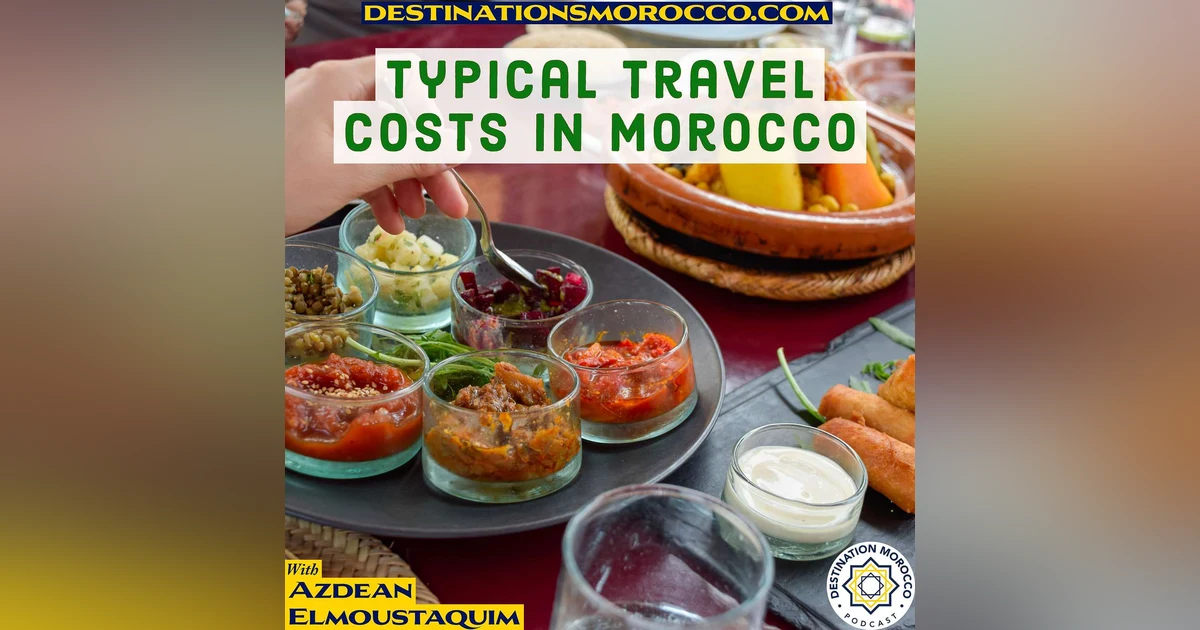

It can be hard to get a clear picture, so our episode today is here to help: "How much do things cost in Morocco?" As much as there's the standard answer, "It depends," we go a little deeper than that and try to frame costs around certain standards and levels of service. Whether that means different types of accommodation, the cost of meals at sit-down restaurants, do desert camps vary greatly in price, how much are activities such as a Hot Air Balloon ride, and lots more. There are a couple ...
It can be hard to get a clear picture, so our episode today is here to help: "How much do things cost in Morocco?"
As much as there's the standard answer, "It depends," we go a little deeper than that and try to frame costs around certain standards and levels of service. Whether that means different types of accommodation, the cost of meals at sit-down restaurants, do desert camps vary greatly in price, how much are activities such as a Hot Air Balloon ride, and lots more.
There are a couple of possible yet unrelated preconceptions about Morocco that we should address. For one, folks might think that Morocco is a budget travel destination akin to Thailand or El Salvador, where your dollar goes very far, decent accommodation is well under $100/night, and an amazing meal costs $5.
Well, that's not the case in Morocco, our costs aren't quite that low!
Secondly, costs in Morocco might simply seem unknown, with no real frame of reference. Maybe it's expensive, maybe it's not, how can you know, and what can you relate it to? And when you see the cost of something, are you getting the appropriate value for that cost?
Morocco generally speaking fits in somewhere between the costs of Western Europe and Eastern Europe. Not quite as expensive as France or the UK, but not as inexpensive as maybe Albania or Poland. Similar prices to what we often see in North America, but also very good, and certainly unique value, whether it's in our distinct accommodation (riads) or our one-of-a-kind cuisine.
So our goal here today is to help give you a frame of reference and ease the sticker shock that might come otherwise. And to therefore help you plan better, know what questions to ask and make an educated decision on budgeting for your trip!
You can also watch the video version of this episode on our YouTube channel here:
"Typical Travel Costs in Morocco"
Join me for an 8-Day Boutique Moroccan Experience!
https://trips.destinationsmorocco.com/Morocco-2026
Step inside the hidden Morocco on this first-of-its-kind, 12-spot journey, hosted personally by Azdean.
November 8-15, 2026, $1995 USD Per Person
Book Your Spot Today!
Learn more about Azdean and Destination Morocco.
AZDEAN ELMOUSTAQUIM: Welcome back to another incredible episode of Destinations Morocco Podcast. Again, in this episode we have Ted. Welcome back, Ted. It's, always a pleasure to have you and, I love our chat, I love our, talks and, I really, treasure them. So can you tell the audience today what do we have in stores for them, please?
TED CRAGG: Sure. you were mentioning to me not too long ago, you, get a lot of questions, of course, about costs and budget and stuff like that and we could take various approaches to that. Some people don't necessarily want to address costs right up front. Others do, tell me how much these things cost.
And we thought, let's be direct about it. Let's try to give some hard numbers or at least a range so people get a sense of the value when you learn about how much certain things cost and then what you get for that price. And we can talk a bit about kind of comparisons, but I'm sure a lot of our listeners and viewers can, compare, make their own comparisons, to the things you're used to, whether [00:01:00] it's accommodation or food and et cetera.
So it, it framed around the question of, what is a realistic per person per day budget range for travel in Morocco, do- not including flights, basically, once you're there and you got your accommodation, transport, food and, activities was the four big ones. So yeah, that's a big question, but there's lots we can pick apart here.
So where do you want to start?
AZDEAN ELMOUSTAQUIM: that's a really good question. So it really, the price really, changes, depending on the accommodations. That's what really can make, a tour affordable, if you would, to a lot of people or very expensive to others. So if you look at the places that you're gonna visit, they're all gonna be the same.
if you look at the entrance fees that you're gonna be paying, they're all gonna be the same. Those are the constant, they don't really change. and the way that we do the tours, basically everything is taken care for you. From the moment you get to Morocco, transportation is included, [00:02:00] breakfast is included.
If you're doing the southern part of Morocco, your dinner is included because there's nowhere else for you to go to have dinner. sometimes we do local guides, depending on how many people are traveling. when we have a small group, maybe five, maybe six, we, definitely recommend a national tour guide so that travels with you throughout the tour.
So those are really gonna be the constant cost if you would. And everybody literally charges the same. Then when you look at the item already, for example, eight day, 10 day and day by day, the cost of the accommodation can make a big difference, staying somewhere where it costs around $100 versus staying somewhere where it costs, $500.
That's really, what makes an itinerary, affordable versus premium versus expensive or luxury, if you would, Ted.
TED CRAGG: Yeah. I suppose it comes down to what people are looking for, but, we always talk about on the show the value and the experience of [00:03:00] staying in riads and the irony in a sense is that, you don't have to pay 500 dollars a night at a certain luxury hotel brand or something like that.
You can pay a lot less than that and stay at a beautiful riyad, which is small and intimate and, fairly private. There's what usually four or five rooms kind of thing and, it feels like you're staying in someone's home. That's the whole point. And it's amazing value and there's, meals there too and often like a rooftop patio or the courtyard or a pool, all these kinds of things, So pe- it's not necessarily based around, just like cost itself, but I guess depends where you stay, but what would be an average price of a, a nice read in a place like
AZDEAN ELMOUSTAQUIM: in a place I would say between a hander to handled, is a nice range. and again, we talked about this many times in the past episodes and even just regular conversations, you and me, there is no system in Morocco. This is part of the system that it does not exist in Morocco [00:04:00] and, for us locals, it's good, because we know how to take advantage of it, but to the Westerners, to the foreigners, to the tourists, because there's no system, it's difficult for them to relate to it.
And I'll give you an example. we're talking about Aria, just the way that, that you have described it really, nice, beautiful, versus going, for example, to, to, a brand name, a hotel like the Four Seasons, St. Regis, those expensive brands. to them, anything you need extra, it's gona cost you, versus the riads we have a relationship with them.
we've been working together for a long time. A lot of that stuff doesn't cost you an additional thing. So let's say for example, a breakfast and if you need more food, they'll get you more food. Let's say we, we have a dinner for you at the reyad, you can eat. If you need more food, they'll get you more food.
most likely it's not going to be an additional cost. And again, it's very affordable because we know those, the suppliers or the reyads that [00:05:00] we work with, they'll take care of you just, just like you're part of the family, literally. and that's the benefit, for us.
It's that relationship that we have with them. and this goes the same way, Ted. I've had this many times, "Hey, I need to know where I'm staying, for example, in robot, or Casablanca and stuff." and when I give them, then I give them a link and say, "Hey, this read, doesn't have good reviews or doesn't even have good websites."
You have to understand, because there's no system, it's just part of it. A lot of those places, they don't even have their own website. The reason because they're working with Expedia, they're working with Booking.com, they're working with other OTAs and they're getting enough business out, out of those platforms.
And just like you said, Ted, they have four, five, six, seven, maybe eight or nine in our rooms, they will get filled quickly. They don't need to, spend that money to build that website. To us, it's, it doesn't look good [00:06:00] because they look to us like they are cheap. They are in, they're not even investing in their own business, but to them it's like, "Hey, that's an extra cost that I'm, I'm good.
I don't need the website. I don't need social media." this is, so funny because I remember about three years ago, we had a Jewish tour and one of the restaurants that everybody recommends in Morocco and I'm trying to look at it and they don't even have a really good website.
and that place to book it, you need a couple of weeks, couple probably months to, to, have a reservation because it is super popular. So that's the mentality that a lot of people still have in Morocco. I don't need a website, I'm working with so- all those e- OTAs, I get enough booking from them.
TED CRAGG: Yeah, interesting.
AZDEAN ELMOUSTAQUIM: yeah, and again, it's just, because there's no system. So those are the things to, take in consideration, pay attention to when you're trying to book something in Morocco.
TED CRAGG: Yeah, and as, by system, as much as anything, you mean there's no kind of [00:07:00] networks or chains or franchises or that kind of thing. is there, do you know of any riads maybe where they have different branches right in different cities under the same kind of company?
AZDEAN ELMOUSTAQUIM: they, they do exist, yes. They're very, not a lot of them, but also one thing that I have, seen, there's a lot of brands nowadays, international brands like the Marriott hotels, for example, they're, everywhere literally in Morocco and they look different than the US. they have done a really good job, in terms of integration with the locals, with the, culture especially, but they also invest in, in a reals.
They have their own riads, because they, realize the importance of having a riad added, to your accommodation, to your hotel because some people, they want to stay, at a familiar name, familiar, hotel like, like the Marriott, and some they just say, "Hey, I feel comfortable.
I work with the Marriott. I travel, I stay with them throughout, and I'm happy to hear that they have a [00:08:00] riad that I can book and stay."
TED CRAGG: So are you saying like they ho- they've bought riads that are off property or they've built riads on their property if they had space?
AZDEAN ELMOUSTAQUIM: some are on property, some off property and they are part of the hotel, yes,
TED CRAGG: Okay, that's interesting. So what do you, would you say those are, authentic riads or
AZDEAN ELMOUSTAQUIM: they're really good. yes, they're really good, yes.
TED CRAGG: 'Cause they don't stem from like the old family home
AZDEAN ELMOUSTAQUIM: yes, they're different. In that, that regards, yes, they are different, yes.
TED CRAGG: But it is that same kind of more intimate, private, and different. You're not staying in a hotel room, walking down a hallway kind of thing.
you're very much staying at what feels like someone's home.
AZDEAN ELMOUSTAQUIM: Absolutely, yes.
TED CRAGG: yeah, so I s- if, we, can only rely so much on kind of internet and Google reviews and all that kind of stuff, where do people go to decide, where to book and how to determine what's [00:09:00] gonna they're gonna get the value for a particular read, right?
AZDEAN ELMOUSTAQUIM: it's, if it's a B2C, if you're booking on your own, traveling or e- on your own, just make sure you do your homework. I see a lot of people, relying on Google, ChatGPT and, AI, and a lot of that information is really, not accurate. I see others relying on OTAs, those, online, travel agencies, and, there's still quite a bit of risk into it as well.
If you're a travel advisor, select the tool, a tour operator to work with, that's your option, because it is very important to, to, trust somebody and work with somebody locally, because it does make a big difference. and the OTA, it's a major, headache, especially for the B2B and I see a lot of trial advisors, they have no idea what they're getting themselves into and what I mean by themselves, what they are putting their clients actually into.
so there's [00:10:00] a lot of risks that is, that, that is involved and,
TED CRAGG: Yeah. that's another question. It's a bit off topic, but about accreditation for travel companies like yourselves or, these online travel agents, is there any kind of licensing accreditation system that
AZDEAN ELMOUSTAQUIM: Okay. just to give, this, really needs an, honestly an episode by itself, but, just to give you an idea, an OTA, for example, Expedia, for example, booking, get your guide, just naming names, hopefully I won't get in trouble, but, in general, the OTAs, it's, an online platform.
Something happens in destination, you cannot talk to anyone. You cannot call somebody at 3:00 in the morning and they'll answer. They are not. You're just, you're on your own. when you work with other OTAs, for example, you don't have access to the company that it's going to be working with you.
If you need to make some changes, they don't give you that information ahead of time. You don't know it, until the tour gets really [00:11:00] close. the agents, when you're working with an OTA, I promise you, that's again, because Morocco doesn't have any system, 95%, yes, I said 95% of those companies that you see, just Google OTA, whatever, you'll see them, they're not, authorized.
you go to Merzuga, somebody, they have a camel, they call themselves a, travel agency. they have a website, they have a Facebook page or a Facebook, whatever, and now they're, a travel agency. Just to give you to, be a trial agency in Morocco, it is the equivalent of becoming a doctor, anywhere else.
It's, it is, trust me, it is super difficult. that's why when I see somebody working with OTAs in Morocco and say, "Hey, found the store cheaper with this guy in Morocco. Okay, good luck because you don't know what's going on. You have ... " And I'm not there to tell you, "Hey, da, and, educate you, that's your decision.
I respect it, disagree with it, " and that's my personal opinion. So [00:12:00] there's, a lot of gray areas when it comes to the OTAs. yeah, it's very risky.
TED CRAGG: Yeah, that's interesting.
All right. you mentioned Merzouga there. It reminds me of, staying in the desert. So coming back to pricing, when it's staying in the desert, is there much difference between the desert camps as far as prices and, I guess the levels of stars and accommodation between the camps?
AZDEAN ELMOUSTAQUIM: Okay. when you look at Merzouga for example, at some point all the camps, or I would say probably 90% of them did not really have air conditioning because they believe they want you to have the local experience, the immersive experience, part of the culture, but to us, Westerners, it's just too hot.
I want to feel comfortable, but I still want to feel, be in the sand, do the camera ride and all that stuff. So for quite some time, there was the conflict. The locals or the owners of those, camps, they didn't have an air conditioning install just because of that. It's not, they didn't want to, but, even the one [00:13:00] that we stayed in, some time ago did not have air conditioning and that was one of my biggest concerns because we were there July
TED CRAGG: Oh,
AZDEAN ELMOUSTAQUIM: and it was pretty hot.
So now they have air conditioning and it makes a huge difference. So when you look at Merzuga, for example, the camps, no camps are created equal. A lot of the camps, I would say the majority or probably half of them are small. They cannot accommodate, 30 people, 40 people, for example, but there are camps next to each other, which the group can be split.
If it's a group, if it's, five, six, eight, 10 people, it's not a big deal. So when you look at the camps, there's the bare minimum. When you look at them, they're, they look like they are black tents. They're just, not really well built, if you would. there's no, shower inside, everything is shared, everything is outside, you just go inside and, sleep.
most, they don't have any air conditioning. breakfast will always be included. dinner will be included in any camp. So regardless wherever you're [00:14:00] staying, breakfast and dinner will be included, but that's the lowest level of camps in Merzuga. Then you go, they call them premium, which, you'll have, your own private, shower, private water and all that stuff in camp, and it is private.
It's not shared with anyone. some will have air conditions, some may not have accusations. Then you go to the luxury, which will have the bells and whistles and, it's nice beds, big, it's really, nice and you can feel the difference in all those, camps. Now, when you said that when it comes to price, it really depends on the season.
I've seen places where you can stay for $50 a night to places where you can, you know, $500 a night to $600 a night depending on a- availability. Now, we are in 2026 and I know last year it was busy, it was crazy busy, and it's gonna stay that way. It's gonna stay consistently busy in Morocco,
TED CRAGG: what's the high season for desert camps then? Is there any particular
period? [00:15:00]
AZDEAN ELMOUSTAQUIM: all the hot season, it's, it is definitely spring, which is March, April, May, June is still good. It's still gonna be a little bit hot, but July and August are just, they are really painful, unless, you have no, no other time to go, And then I would say November, in the first two weeks of December, they get really cool.
the second week of December it gets very, cold. last year when we went it was unseasonably cold so it was, zero degrees, it was below zero degrees in, the mountains so it was very, cold. So first two weeks of December are okay.
TED CRAGG: Yeah, okay. So people will see prices reflecting that, if you're wondering when high season is and so on, or low season in turn, then, yeah, that's how you would frame it.
AZDEAN ELMOUSTAQUIM: absolutely. So if you're traveling, spring of next year, this is the right time to book, not just Merzouga anywhere in, in Morocco [00:16:00] because those bookings, they really go by quick. So yeah, just plan ahead of time.
TED CRAGG: let's talk a bit more about food because, with a typical tour, a lot of meals can be included, but sometimes you're on your own for lunch or a dinner here and there, whatever it is. is there an average price, of, you go to a typical local, standard restaurant, not, like a, not like a food stall or something, but a sit down restaurant with a menu, like how much would that cost?
AZDEAN ELMOUSTAQUIM: A sit down restaurant, a local restaurant, it should cost you an average $25 with no alcoholic beverages, if you would. So that's the average, $25 for lunch. Now dinner, for example, it just depends on what you're gonna have, it's just a regular dinner.
A- again, it could be around maybe, 30, 40 bucks. If you're gonna have an experience, for example, dinner and a show and again, depending on the city, if you're doing it in, in, in Merzouga for, Merzouga is included. If you're gonna do it in Agafai, [00:17:00] in the outskirts of Marrakesh, it's different. If you're gonna do it in fast Marakesh or, at a restaurant, a local restaurant, dinner in the show it's probably gonna cost, I would say somewhere around maybe 80, 85 bucks per person.
And again, alcoholic, beverages are not included in the price. but that's, the range that you need to, look at. So some places might, be cheaper than others, but that's the average,
TED CRAGG: Yeah, okay. I wanna try to address with our conversation here that's like the impressions of cost, in Morocco and for people who've traveled to, places like, I don't know, Thailand or Central America and places, and things can be pretty cheap in, in, in a good way.
Like it's good food and everything, but it's just the nature of the economy, right? Like it, things are much more affordable there. And so perhaps people have that impression of Morocco. Now, you're giving us prices here that reflect, we're clearly not talking, nice accommodation that's $40 a night.
Like you'd be 150, [00:18:00] $200 a night type of thing, but not necessarily as expensive as a lot of places in Europe or I guess the States and so on. So what about activities like, I don't know if offhand, but if you did something like, maybe a hot air balloon ride,
AZDEAN ELMOUSTAQUIM: Yeah.
TED CRAGG: how much might that cost?
AZDEAN ELMOUSTAQUIM: the hot air balloon, it's, it has gotten so popular and, it's getting a little bit more pricey. the hot air balloon, most of the time it used to be done in, Marakesh, now you can do it in few different locations, places in Morocco. You can do it in Marrakesh, obviously, you can do it in Dades Valley, towards the southern part of Morocco when you're doing the, southern, or the desert tour.
but just to give the audience an idea how it works, basically, the hot air balloon is a completely different company so they'll come to you, and pick you up from your yard, wherever you're staying, they'll take you, the location is, it's in the outskirts of Marakesh a little bit. If you would then, the Medina, they'll serve you breakfast, then [00:19:00] you'll go on, they show you a little bit of training, then you'll go on the ride.
The ride normally takes about an hour, this is all before the, the sun comes up so you can see that on, while you're on the ride. And then when you're done, they drive you back to the read or your accommodation. So transportation, a round trip is included, breakfast is included, then the experience is included and it's done offsite of Marakesh, all the hot air balloon companies, that's what they gather.
It's one area for everybody, just the same if you would in, in Merzuga where they gather all the camels in one area, then everybody goes their separate ways. the hot air balloon per person, it really depends, but it's, it, could be between $200 per person to $300 per person. So And before when you make an arrangement, this one can be done prior to your tour or we can build it in, into your itinerary, for example, and they will reach out to you a [00:20:00] day before, the evening before and say, "Hey, Ted, I just want to confirm that tomorrow you have, a hot air balloon experience.
It's going to be four of you, for example, and we're going to be picking you up at 5:45 in the morning or six in the morning or five, so they'll set everything, you'll get a call, you'll get a text, so everything is confirmed with you and they pick you up and drop you off. So the good thing about the hot air ballooning really does not really interfere with everything that you have planned during the day.
So everything is done early, by eight o'clock or so, you're back at your way out and you're good to go.
TED CRAGG: Yeah, okay. that's great. Yeah, it's a lot included for price and it's, a good price, I think people would expect that for an activity like that.
AZDEAN ELMOUSTAQUIM: Absolutely.
TED CRAGG: the other popular one is, is the hamam and the spa, like whether it's an afternoon maybe, let's say, I guess three or four hours, like how much might that cost?
AZDEAN ELMOUSTAQUIM: the cost really varies. I've seen some, [00:21:00] depending on packages, normally anywhere you go, they'll have 30 different packages. The royal package, they call it the most expensive and I think that's, a similar name anywhere they go. and I've seen it go in between $100 to 250 to, to 450, depending on where you're gonna have the experience, for example, the, Hemema experience done.
So the mussage has its own package, Hemam has its own package. Each experience, will last 45 minutes, there's a little bit of a break in between the two. They'll serve you Moroccan pastries, Moroccan tea, then there's a little bit of a recovery room after you, you finish with the experience, then we'll pick you up afterwards.
we always recommend it in the afternoon, especially sometimes in the middle of the tour if you're having 10 day or 12 day because you will absolutely get tired. A lot of people are really excited, but they don't realize they're gonna get tired at some point. and it goes ... The Massage and Hemam goes really well with, [00:22:00] either cooking class in the morning or some activities, light activities, at night, dinner and, the show, for example, goes really well with it as well.
TED CRAGG: Okay. does the hammam ever last a full day thing? Is it really
AZDEAN ELMOUSTAQUIM: no, it's not a full day. It's, the, Hammam experience will last about 45 minutes. So you'll get picked up from the yacht, you'll be taken to the Hammam or Spa area, so that whole experience should be about two and a half to three hours all of it,
TED CRAGG: Yeah. Okay. Yeah, because that's, helps people frame, like you say, the hot air balloon, what else you can do in the same day, bearing in mind that you will be a little zonked out after but it's worth it. I want, the last thing I wanna ask you about here is, the famous tipping. now granted, of course, when you're on a tour, your guide, should prepare, be prepared for that, i.e.
Have the change, also know who [00:23:00] to tip, how much to tip and really guide you in that way. but often us, of course, as travelers on a tour, we wanna be able to do it ourselves, obviously a- add some extra or just have that kind of independence, So can you give us a sense of some of the prices that people are tipped, whether it's for luggage or drivers or, waiters or anything else and the second part is how do people get the change that you need to tip?
AZDEAN ELMOUSTAQUIM: That's a really good question. We have a cheat sheet, if you would, and I, sent it to people when they, request it. this one we have it as if there are two people traveling. Then it's different when you have a group of people that are traveling. So first of all, when you get to Morocco we pick you up, there's a lot of the times, you need to get, money exchanged.
I don't recommend it doing whether it's in the US, Canada, New Zealand, anywhere else, just wait until you get to Morocco because that's what we're there for. We pick you up and we help you, [00:24:00] get actually better exchange rate for you, because we know the places to take you, whether it's in Casablanca, Fes, Marakesh, and so forth.
if you need to get something like for your, outlet, something like this,
TED CRAGG: okay. Yeah,
AZDEAN ELMOUSTAQUIM: is really ... It goes a long way. This costs about a dollar to two dollars, and I have, I always have extra. if you need some, just let me know, I'll, send them to you. or when we have group of two, we always buy extra and just give it to, to, to the travelers when they need it.
So it's very important to, get the best value for your money because, it adds up. So that's the first thing. The second thing is ... I forg- I totally forgot the second part of the question.
TED CRAGG: how much, how much do you tip people for various
AZDEAN ELMOUSTAQUIM: the, tip in part, for example, when, let's say you have eight people and then above eight people, I would say for breakfast, lunch and dinner, it should be the same. [00:25:00] $2, it's more than enough because it adds up. $2 person that's with, eight, that's, really, generous.
housekeeping, I would say the same thing, probably when you're staying, maybe five bucks, that's really good. Then the luggage handlers and this is, it's very important to know how much to tip depending on the luggage that you have. But I think $5 is more than enough, for, for a couple even, for luggage. When you have a group, this is very tricky when you have a group, it's really important, for the group, it's a, let's say you're traveling with a, with a travel advisor and that's their group, you have to communicate to them and say, "Hey, the luggage that you have is okay or luggage is too much or it's a lot of
So they know, how to tip accordingly. and then also what we do, we're there with you, we're watching. If, we see the body language of the people that are helping you, we can tell whether they're happy with the tip or not happy with the tip because, [00:26:00] the thing that we don't want anybody to have is, somebody not wanting to help us with the luggage.
so it's really, important. I cannot really put a price to it, because sometimes it's dependent on the group size, but, again, if we see that you don't, you didn't tip well or, didn't have enough cash, then we, step in and we take care of it. and the same thing.
Sometimes they just forget, and you, if we see that you have forgotten or somebody comes and say, "Hey, your client forgot to tip or this, then we just tip them, accordingly and, we just leave it at that. " So we don't, go and ask and say, "Hey, you forgot." No, we don't, So those are the things that we, we do for everybody, and it's, expected from us. So when you have, your national guide, tour guide, that's what, they pay attention to. Then you have your driver with you at all times, those are the small details that they pay attention to. The reason why, because that national tour guide [00:27:00] is gonna work with somebody else and they're gonna go back to that same hotel or real, then they're gonna see those guys again and we don't want them to have, conflict or relationship and stuff like that.
The same thing with the drivers. So it's very important for us to make sure that everybody's taken care of, and it's
TED CRAGG: Now, how about w- if you're on, let's say a small group too, not necessarily a private tour, but maybe, there's six or eight of you, let's say six people and you all fit into one van and you have a national guide who's with you the whole time, let's say probably 10 days. So at the end of the tour, how much should each person tip their guide for that whole 10-day
AZDEAN ELMOUSTAQUIM: say when you're working with local guides, you tip the local guide at the end of their experience with their, when they're done showing you the city, the, attraction and stuff like that. When it comes to the national guide, which is similar to the tour leader and the, driver, you [00:28:00] tip them at the end of the tour.
Not every day, but you just keep it at, until the end of the tour. So for 10 days, I would say probably around maybe, $600, for, the, National Guide, $500 for the driver. but here's the other thing that, when we talked earlier about the system, this is how the system is in Morocco.
So when you have a national, guide, tour guide, they have their base price. Then the tip is something extra. If you feel that they have gone above and beyond, then you tip them extra. and that's, everything we're saying is just a recommendation, it's a suggestion. then the same thing for the local, for the drivers.
The drivers, they all have a base price. Whether they do a tour in a month or 10, they get paid the same. The difference is they leave off that tip. So when they go with you, they're really expecting [00:29:00] the tip at the end of, the tour. So that's why they're willing to do things and accommodate and go above and beyond and stuff like that.
So there's, a base price just for, whether you're a travel agent, whether you're just, just a regular client who's gonna travel. So those are the things to take in consideration. Everybody has, a base price that they get paid. Then the tip is really extra, but then again, it just, it shows, you supporting him or her and their families and stuff like that.
So tipping in Morocco, it used to be taboo, but now it's really,
TED CRAGG: Yeah, I
AZDEAN ELMOUSTAQUIM: and, yeah, so it's very welcomed,
TED CRAGG: Yeah, okay. Good. that frames some things then for sure. we've talked about, accommodation and food, activities, tipping. Yeah. it helps, the goal here is so that people aren't totally in the, dark about, what to expect, especially extra [00:30:00] costs and un- unexpected things.
So yeah, I think that gets some of that information out there and helps people to, calculate.
AZDEAN ELMOUSTAQUIM: Yeah, absolutely. Yes. and also, we talk about the food tours, we talk about the cooking classes and those are a- again, a cooking class, is a cooking class, but what makes it is what's included in the cooking class and also where it has been done and held, we can do it in the desert, where everything is organic.
you pick the vegetables, you pick the meat, everything is just, it's right there. Then we can do it in, at a private farm, outside Marrakesh. And again, in the, in, in that experience, you have options, you can do it, with other people, so they put everybody in one room, or you can ha- it has a different price.
Then you can have it just you, for example. If it's just two of you, four of you, a family, or a small group, you'll have that private small group and you'll have the chef, doing everything, helping you throughout the whole process. And again, everything you have is at the farm, [00:31:00] it's right there. So or you can have your read and again, the reality is different experience.
You can go to the market and pick up the vegetables, pick up everything that you're gonna have for the cooking class, or you can have the riad pick everything for you. You just come in, you, prepare you get it done. Those all have different prices. they can be, from 100 bucks per person to probably to 50, 300 dollars a person.
And again, the difference is in the details. So everything really has different prices, if you would, Ted. but, when you look at an itinerary as a whole, you add a little bit here and it's six people that are going, for 10 days. It really adds up. It's, now it's not just 100 dollars, it's quite a bit of money, so yeah.
TED CRAGG: Yeah. Oh, that's just it. we don't want people to, be surprised I guess, when it, comes down to it and, as part of your budget planning in general, I've certainly learned this. I'm sure you have too, that when you're [00:32:00] planning travel, whatever it may be, like, you gotta leave that cushion right for extra things, unexpected things and, yeah, it just helps to frame so you know what to expect.
AZDEAN ELMOUSTAQUIM: absolutely. and I just wanna talk about budget, if you would please, Ted, for, the B2B part, it's very important, for travel advisors to know their client's budget and most of them know. Sometimes the client, they say, "Oh, I don't know. I don't have a budget. I'm just, looking and all that stuff."
And then when you have the B2C, somebody comes up to me and we're talking about, planning their vacation, yes, I do get that person, "Oh, I have no idea how much it's gona cost. When I don't really know, I don't have a budget." So the majority of people when they say, "I don't have a budget," probably they're not gona go with you,
TED CRAGG: Right.
AZDEAN ELMOUSTAQUIM: because, Morocco is not cheap, it is expensive, now, [00:33:00] especially when you look at Marrakesh, you look at 10 year, for example, I've been to London, Marrakesh is more expensive than London.
and we talk, I, promise you, I, I promise you, Ted, we look at Morocco last year, last couple years, it's been the number one destination in Africa. between Morocco and Egypt, it's, about 40 million, that's half of, the, people that visited Africa, half of them went to Morocco and, Egypt and those numbers are only gonna bigger and what that did to Marrakesh, it made it more expensive today.
just to give you, the, when we look at the numbers today, almost July 2026 compared to pre-pandemic, the numbers have gone up, an average of 35% and
TED CRAGG: Now you're talking like the cost of living or the cost of travel
AZDEAN ELMOUSTAQUIM: cost of travel.
So the tours they used to be able to book, for example, with $2,500 today just added an additional $3,500, the same to the same everything. we [00:34:00] talked previously on the accommodations, they go up every year between eight to 12%. Transportation the same, gas prices, look at them. now they are coming down a little bit, which is good.
So all those things, they have to be factored into the, experience into the, itinerary, into your bill. So it really adds up. Morocco, again, it's not cheap. It's not a cheap location. this is not even including air travel, Ted. So yeah,
TED CRAGG: But we still want people to go.
AZDEAN ELMOUSTAQUIM: 100%, yes.
TED CRAGG: the, prices are where they are. It's, nothing that you and I control. It's, it's obviously the economy and you could argue that as, the country gets even more popular and more tourist, that diversifies things so you may have ... I know one issue we talked about a bit over the years is just the capacity.
There hasn't been a lot of capacity available, right? Especially for accommodation because they need to build more hotels, maybe some riads are modern read alternatives, right? But [00:35:00] the, just the, space hasn't been there. So the more things diversify and evolve over time, that means there's more choice and it gives you some more different levels of affordability.
But yeah, it all comes down to knowing what to expect at this point.
AZDEAN ELMOUSTAQUIM: Yeah. the accommodations are being built as we speak. last time I was there, I've, seen construction throughout, Casalanca, Marrakesh, Fez, the, it's really changed at a very, fast pace, that, I have not really seen in decades in Morocco. So the investments are there, things are being built, yes, for big companies, big, corporations to get ready for those big events.
TED CRAGG: Good. we'll leave it at that. That's good. Good overview. Yeah, I'm glad we talked about that.
AZDEAN ELMOUSTAQUIM: Thank you.
TED CRAGG: we'll see you next time.
AZDEAN ELMOUSTAQUIM: Thank you so much. Appreciate you listening. Have a wonderful day.
TED CRAGG: Cheers.