


 Apple Podcasts
 Amazon Music
 Castro
 Spotify
 RSS Feed
 iHeartRadio
 Sharing the Heart of Morocco Through Adventure, with Cat Caldwell Myers (The Adventure Paradox podcast)
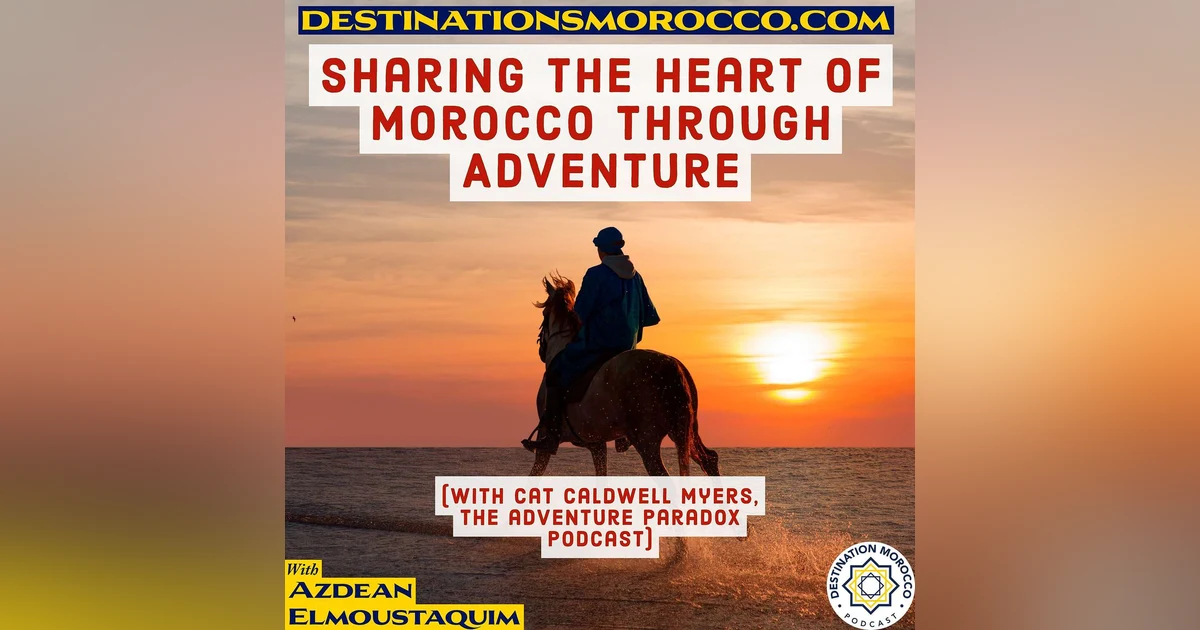

Azdean had the pleasure earlier this summer of chatting with Cat Caldwell Myers, host of the Adventure Paradox podcast, a show that empowers motherhood through adventure, building relationships and being in the moment.
We love having the opportunity to introduce people to Morocco, to fill in some of the gaps in information, to inspire their curiosity and learn more about the country, and ultimately: to visit.
Cat was a great example of this, someone who blends outdoor adventure with entrepreneurship, women's empowerment, podcasting and travel. And she loves working with horses: Cat is a riding instructor, wrangler and coach who shows people how to integrate the outdoor adventure and ranch lifestyle into their lives.
Most notably, earlier this year Cat did a TEDx talk on this subject, which we've linked to below, along with her website, podcast and more.
And so it was super exciting to have the chance to link her various passions back to Morocco, a place where Cat and her followers can find more opportunities for adventure, push their limits and discover new cultures.
Which made us realize, this is a powerful message for our listeners here too, so we're happy to share the conversation with you, here on the Destination Morocco podcast.
Learn more about Cat and The Adventure Paradox podcast:
👉 Go here to HEAR the Tedx talk!
✨ Join the Spiritual Horse Seeker Summit
✨ Order Wings of Purpose — now available on Amazon https://www.amazon.com/dp/B0GYL381CS
Discover the podcast:
AZDEAN ELMOUSTAQUIM: It has been a pleasure chatting earlier this year with Cat Caldwell Myers, host of the Adventure Paradox Podcast. We have a video conversation also appearing on the audio podcast apps. We've talked about cultural and adventural travel to Morocco. I love having the opportunity to introduce people to Morocco, to fill in some of the gaps in information, to inspire their curiosity, and learn more about the country, and ultimately to visit.
Cat was a great example of this, someone who blends outdoor adventure with free enterprise, women's empowerment, podcasting, and travel. also, she loves working with horses. Cat is a riding instructor, a wrangler, and a coach who shows people how to integrate the outdoor adventure and the ranch lifestyle [00:01:00] into their lives.
Most notably, earlier this year, Cat did a TEDx talk exactly on this subject, which we've linked into our show notes for this episode. And so, it was super exciting to have the chance to link her various passions back to Morocco, a place where Cat and her followers can find some more opportunities for adventure, push their limits, and discover new cultures, which made us realize this is a powerful message for our listeners as well.
So, we're happy to share the conversation with you here at the Destination Morocco podcast. Whether you're a travel agent, booking travel for your clients, or someone looking for a private or a small group tour, Destinations Morocco is here to make it happen. We put together full customized itineraries so you can go where you want, [00:02:00] see what you want, and do exactly what you want.
That's the Destinations Morocco way. Visit our website at destinationsmorocco.com, explore your options, and book your free discovery call today. We're happy to answer your questions and get you to Morocco.
CAT CALDWELL MYERS: Hi, guys. Welcome back to the Adventure Paradox podcast. We have been featuring a lot of really unique travelers, hosts of travelers, travelers who wanna help other travelers to take incredible adventures in this lifetime. And today, we have someone from Morocco. I'll give him a formal introduction in just a moment, but I wanna formally welcome you Azdean Elmoustaquim to the show.
Thank you so much for joining us. How are you today, and where in the world are you Zooming in from?
AZDEAN ELMOUSTAQUIM: I'm doing great. I'm very grateful for this opportunity, Cat. Uh, I love your podcast. I love what you do. Uh, it's just, it's [00:03:00] incredible. Uh, today I am, uh, in Houston, Texas. Uh, I was in Morocco a couple of weeks ago.
So I'm, I'm based in Houston, so.
CAT CALDWELL MYERS: Fantastic. And I know you're from Morocco, and we're gonna talk a little bit more about maybe what it was like growing up there, how you came to Houston. But for those who don't know, Asdin is the founder and chief travel planner of Destination's Morocco Tour Company. How did your business come into being?
Let's start there.
AZDEAN ELMOUSTAQUIM: Uh, that's a really, really good question, Cat. Basically, um, we traveled back and forth, me and my wife, to Morocco, and we have been doing it for some time. Uh, and it was perfectly fine, but then when we had our son, it was really important for us, for him to know and understand where he comes from, his, uh, you know, his background, his roots.
So that's why we created Destinations Morocco. And doing so, it really, I mean, we feel in love back with the country. We just love it. We, uh, we took it for granted for so long, and it just, [00:04:00] um, since then he, uh, he went back to Morocco about three times. He speaks the language fluently. And, you know, when we go to shows, he does, you know, his thing and, and, and he sells Morocco really better than I do, so it's incredible.
CAT CALDWELL MYERS: How old is he now?
AZDEAN ELMOUSTAQUIM: He's 10.
CAT CALDWELL MYERS: Oh my gosh. My, my daughter is also 10. And I, I can see it. I mean, they say a good business pitch if you can't explain it to a five-year-old, it's not there. And then when your five-year-old or 10-year-old starts explaining it to you, you're like, "Yeah, that's it."
AZDEAN ELMOUSTAQUIM: That's it.
CAT CALDWELL MYERS: So good.
So good. So what is the native tongue of Morocco?
AZDEAN ELMOUSTAQUIM: Say that again, please, Cat.
CAT CALDWELL MYERS: The native tongue of Morocco, you said he speaks the language. Oh.
AZDEAN ELMOUSTAQUIM: Yes. The native tongue of Morocco is, it's more of a dialect versus a language. It's called darija. Um, just to give you an idea, uh, comparing darija to the formal Arabic, uh, like Middle East, uh, Egypt and North Africa, uh, we understand their dialect of Arabic and they're Arabic, but they cannot [00:05:00] understand ours because ours is a really mixture of a little bit of Spanish, little bit of French and German, and a little bit of Amazer language.
So it's kind of a, a buffet of languages, if you would. So that's our mother tongue, uh, in Morocco.
CAT CALDWELL MYERS: Wow. Yeah. I know Morocco, a lot of different cultures, a lot of trading, the history. Is that sort of how the dialect evolved? Like, I'd love to hear a little more about the history of the language and
dialogue.
AZDEAN ELMOUSTAQUIM: Oh, absolutely. Um, the, the indigenous people of Morocco, uh, are burbers. So that's. And, and the language, uh, when you look at the, the, the burber, the Amazer people, the language is widely spoken in North Africa. Uh, some in Morocco in Algeria is called Kabali language, uh, Amazer as, as well. A little bit of parts of Tunisia, a little bit of Libya, and a small part in, in, in, uh, Swan in, in Egypt, which is a surprise to a lot of people.
So when we talk about Morocco and the Amazer language in Morocco, there are many different languages that are [00:06:00] spoken. There's the, the Rifi language which is spoken in the Rief Mountains in the north side of Morocco. And this one is completely different language. Uh, the other ones, the, uh, the other Amazi languages that are spoken in the rest of the parts of Morocco, they are somewhat similar.
You can understand some words that are different, but you can still get the communicate and get the, the, the whole point. But the one in, in, in the north side of Morocco is totally different. So that's the original language of the Amazer people. Then Tarija came afterwards, uh, which is basically, uh, it's not Arabic Arabic, but it's the, the informal language, if you would, of the people of Morocco, so.
CAT CALDWELL MYERS: Wow. Very interesting. I, I always think better understanding, you know, how people speak and why, especially when a dialect is involved and you're traveling is. You don't wanna skip over that as a traveler, you know? It's, it's good to sort of know where it's coming from, especially as you're [00:07:00] learning. I don't know if you have any little tidbits.
I always think when traveling, it's good to know how to say toilet. Thank you. Sorry. Absolutely. Please. Are there any little, uh, pieces of the language or dialect that you share with your travelers to help them get around?
AZDEAN ELMOUSTAQUIM: Oh, absolutely. That's a really good question, Cat. We have, we have done about 102 videos, uh, about Darijah classes, you know, part one, part two, and so forth.
And, and we share them in, in our YouTube channel. We'll give the information afterwards. And basically, it, it talks about exactly what you have mentioned. Let's say you go to a restaurant, you wanna ask for a menu, how to ask for a menu, how to negotiate, how to ask, you know, uh, do you have a toilet? Where is the toilet?
You know, you go to the pharmacy, how to ask, you know, the pharmacist for a doctor, I mean, medicine and stuff like that. So it, it is really, really important. And, and one of the most important ones is, uh, you know, when you greet people and say, hi, everybody [00:08:00] understands hi, hello, but also when you say it in, in darija, like Salem, we say Salem, uh, you just reply back, Salem.
Mm. That means hi back or hello or good to see you and stuff like that. So it's, it's, it's really, really impressive when somebody hears you say, Salem. So I kinda look at it and it's like, "Hey, Salem, Cat." You know, so it's, it's very impressive to know, you know, just a little bit, you know, couple of words. And also it's really important when you go into the Medina, you're probably gonna hear somebody, because it's very crowded and narrow, you'll hear somebody saying, uh which means just get out of the way, coming through and stuff like that.
So when you hear that, you know, just pull to the right hand side because somebody behind you is coming really fast, uh, you know, motorcycle, bicycle, some merchant or something like that. So, uh, yeah, definitely.
CAT CALDWELL MYERS: Wow. Bellek, Belich. If you hear that, move over. Look. I love that one. And I love Salom. It makes me think of Shalom peace - Yes.
In Hebrew, right? Absolutely.
AZDEAN ELMOUSTAQUIM: And
CAT CALDWELL MYERS: that sort of universal [00:09:00] language that when you start really listening at a deeper level, I think we can really hear each other. So I'm curious, when traveling, there's always the super freeway, the, the highway of where you're probably expecting tourists and there are people there and it's a destination, it's in a lot of tour guides.
And then there's the off the beaten path experience that I know a lot of our adventurers listening are interested in going the distance, you know, whether it's summiting a mountain or going to ride horses or camels, and I'm excited to talk about that in a remote area. How do you begin to work with your clients and sort of assess if they might be a better fit for the super freeway destination or the off the beaten path adventure?
AZDEAN ELMOUSTAQUIM: Oh, that's an amazing question, Cat, because it does make a big difference, especially in time, um, you know, using a freeway versus the old routes, if you would, or the, uh, the ones that we used before the freeway. So, uh, uh, just to give you an [00:10:00] idea, uh, if you come in from Fes going to Casablanca or Marrakesh, it's six and a half hours to, to Marrakesh.
Um, and it's a freeway most of the time. But if you wanna take a scenic route through the mountains, then it becomes nine hours. Uh, there's always stops along the way, obviously, but then it really makes a difference going through the mountains. You know, you, you've seen a lot more of Morocco versus just the freeway, which anybody can really take.
And also keep in mind, the landscape in Morocco really changes literally every 45 minutes. It feels like you're in a, in a different country, in different city every 45 minutes, from the mountains to the hills to, you know, to, to the ocean, uh, to the forest. It's just, it's, it's incredible. So that's, that's what driving the Morocco really gives you.
And in terms of, um, you know, the choices, all the itineraries that we create and build for the clients, they're all hand, you know, custom-made. Uh, we don't, we don't have one itinerary that it's similar. It's, there's no two [00:11:00] itineraries that are similar to each other. Everything is built from scratch according to the travel, what they wanna see, how they wanna get from point A to point B, the experiences they wanna experience and, and things they wanna do, including the food, what they wanna have, and, and so forth and so forth.
So everything is customized.
CAT CALDWELL MYERS: Wow. That's, that is awesome. And I love that you recognize, like, there's, there's a big range of what people are looking for and supporting people in customizing and being able to voice what their needs are. And then it changes, you know, you might think, "Oh, I'm gonna hike." And then you hurt your ankle and you're not gonna hike.
So are you gonna enjoy the place you're staying at the base of the mountain or do you maybe wanna upgrade to something else more comfortable now that you're not just sleeping there, you're hanging out there, you know, because you're hurt, et cetera, et cetera. How do you help people feel safe? I'm, I'm vaguely remembering maybe Marrakesh, like, some pickpocketing things, and I mean, all cities, right, preying on, on tourists or people who clearly maybe don't know what they're doing.
But [00:12:00] how do you support your clients to feel safe and maybe specifically women?
AZDEAN ELMOUSTAQUIM: Oh, I love that question, Cat. Um, you know, safety is, is, it's top concern for everybody traveling. Morocco, it's very safe, uh, for solo travelers, for female travelers, but I completely agree with you. When you look at the major cities that, you know, like Marrakesh, which is, uh, it's been a number one destination globally for quite some time, you look at Fes, you look at, you know, Casablanca, you look at Rabat, uh, there's so many opportunity for, you know, for, for scams and big part because the Medina is so busy, it's, you're not gonna feel somebody reaching out to your pocket.
It's just so packed. So, and the best way to do that, to protect, you know, through our podcast, we have, uh, I believe we have four episodes we just talk about scams. And when you listen to those episodes, it seems like I'm, I'm talking negative about Morocco, which I really, really don't, but I have to be honest with the audience and I have to be honest with B, but also it's bringing awareness to the [00:13:00] travelers.
So, and, and we get so many messages, "Thank you. Um, this guy, you know, followed me or, or did this, and he was so nice and so was smiling throughout the time, but I, I knew that a scam is about to unfold, and because I listened to that episode, it really saved me, uh, from, you know, saving money or, you know, bad experience and stuff like that.
So yes, in terms of women, Morocco is very safe. And also the way that we build itineraries, you're really never alone. So the constant, you also, you always have your current driver, literally, uh, all the time, twenty four seven. You have access to them, you have access to us here. In the US, you have access to a manager on duty for you twenty four seven.
Then when the driver is not around and you're, you're doing, uh, the Medina or, or a site visit, there's always a local guide with you. So literally, you're never alone by yourself. And then, you know, they, they see you with a local guide or they see you with a driver, nobody's gonna approach you. So they just, you know, you're not their [00:14:00] target, if you would.
They want somebody just by themselves or somebody that look a little bit lost, they don't know where they are going, they don't know what they're doing. And those are the signs that, you know, people will pick up and, and, and, and, and target you, uh, for a scam.
CAT CALDWELL MYERS: Wow. You're, you're bringing me back to a story.
When, when I was traveling, I was 20 years old.
AZDEAN ELMOUSTAQUIM: Oh, wow.
CAT CALDWELL MYERS: And we were in Cape Town, South Africa, and I wanted to hike table. So I took a taxi cab by myself, Azdean, to the trailhead. Oh, my goodness. And when we got there, the cab driver decided he was gonna try to charge me triple.
AZDEAN ELMOUSTAQUIM: Oh, wow.
CAT CALDWELL MYERS: And we had agreed on the price before we started, and I said, "No, I'm not paying you that," you know?
And he started following me down the trail -
AZDEAN ELMOUSTAQUIM: Oh, my goodness.
CAT CALDWELL MYERS: Asking for more money. And luckily, I could see some women up the switchbacks, and I started yelling and saying, "This man is following me. I need help. I do not want him following me. I have paid my money." [00:15:00] You're just reminding me that experience of, you know, there may be a moment where you are alone and how to work through that, but ideally, if you're working with a travel guide and you're not a 20-year-old who thinks she's safe anywhere in the mountains like I did, I just sort of though, "Well, once I'm out in nature, I'll be okay."
I hadn't thought about the driver himself maybe not being safe, who I just picked up off the street, right? Absolutely. So I'd love to hear a little bit more about, you know, how you ended up in Houston, Texas. You talked a bit about the business, but then also understanding, because it sounds like you're really catering to an American audience, you know, thinking about what are some of the concerns people might have, what are some of the things they might not know?
I love that you covered the top four, because ultimately, it's not just Morocco. Like, these kinds of scams are happening everywhere. Everywhere, that's right. So to better understand sort of street smarts and thinking about really, I love to talk about it as horse sense, but like, hmm, something about this seems [00:16:00] too easy.
This is like, you know, I would love to hear a little bit more a- again about how you're catering from Houston, how you ended up there, and who is your ideal client?
AZDEAN ELMOUSTAQUIM: Oh, those are really good questions. So I, I came to. It's funny story how I came to Houston, to the US. Uh, I honestly, this is my, my, my, my honest opinion.
I never thought that I would come to the US. I mean, uh, going to heaven seems a lot easier than coming to the US. Huh. I, it's just, it's, that's my opinion because I do not qualify in any way, form, or shape to come to the US. And, uh, uh, the way that it happened, I just went to, to say goodbye to one of my neighbors, uh, who was very, he, he, he was studying, uh, in Houston at that time.
And then he said, "Hey, um, you know, if you wanna come to Houston, I can send you the I20," which is, uh, a document that he gets from the university. Um, and then I, I fill it up, the application, they approve me, then I take it with me to the embassy and all the [00:17:00] paperwork that it needed. Um, everything that it's, that it needed for me to, to come to the US, I did not have.
So he did everything for me. His family did everything for me. Uh, all I had to do is just study English and pass the test, which is the TOFL test, which is, uh, uh, I believe it's a test of English as a foreign language or something like that. Yeah. So I did really good in that score. And, uh, and that's, that's how I really came to the US.
And then when I got here for two weeks, I did not, I was, uh, the experience just still feels surreal because I, I just would never though in my wildest dreams that I'm gonna come to, to, to United States. So that's really how I got here, and I'm, I'm super grateful, um, forever. So, and then, you know, uh, being here, uh, with the story, how we started the, uh, destinations, Morocco, me and my wife, um, obviously we are in the US and we're very grateful.
So the US did so much for us in [00:18:00] so many different ways and levels. Uh, and one of them is, um, it, it really made us appreciate Morocco even more. When I see Morocco, I see the culture, I see the tradition, I see the art, the culture. Back then, I was blinded to everything and I took everything for granted. And this is the, the honest truth.
So then we helped so many people along the way, uh, directly or indirectly. Um, and then being in the US, um, and I've been in the hospitality industry for quite some time, you know, when I came, I was just busing tables. Uh, I was cleaning tables at a, at a Mexico restaurant. That's what I did for quite some time.
Then my English improved. Uh, then I went to, you know, I worked at the Olive Garden for a little bit and, you know, I, I kept going up and I worked, uh, you know, in, in hotels, uh, maybe six or seven different chains of hotels. Um, and then I started doing the retail. I worked at Dillers, I worked at Neil Marco, so that's, that's really my background.
So I've always loved helping people, uh, and, and the customer experience was a big part of [00:19:00] it. So when we, we did, uh, start the company, uh, you know, pandemic hit and, and then it gave us, uh, an outstanding opportunity in terms of time. So we had all the time for us to, to look into so many things, tourism in Morocco, how to change, how to make it better, and, and so that's what we did.
So being in the US, and again, it gave me the opportunity that I can relate to the travelers in the US, what they want, what they don't want, how they like to travel, how do they like to be catered to, how do they like to be pampered? And, you know, and, and especially in terms of the culture, I'm very fortunate that I understand the US culture, the American culture, then the Moroccan culture, and, and the similarities and the differences.
So that puts me in a really good position instead of, you know, when somebody talks to me, I c - I can feel what they're saying and I can relate to what they are saying because I've lived here for three decades, and that's, that's just incredible. So, uh, and we'll go back to, to few things that you [00:20:00] said when it comes to, to s- safety and security.
Morocco, again, it's super safe. And I, uh, you know, I went there for a month and a half almost in November, and, uh, when I got there, there was a Interpol, uh, convention. So the Interpol doing their convention in Marrakesh, that tells you big things. I mean, it's, it's very impressive. Uh, then just last week, the FBI, uh, was in Morocco, uh, doing a, a, a tour in the African Cup, uh, of nations because the US is part of, uh, the World Cup FIFA.
Uh, you know, this year, they're, they're, they're organizing the World Cup, uh, America, uh, Mexico, and Canada. So Morocco has been hosting, uh, the African Cup and did a really, really good job. So they were taking, uh, I would say notes and, and tips. So, and again, the, the security in Morocco, the system, the setup is very different than the US.
Um, we have invisible police, we have tourist police that you don't see them. They just look like [00:21:00] every person really in the market, uh, or the Medinas. Then you have, uh, the regular police and different divisions of the police. So in less than a mile away, uh, in any direction you go, you'll see, uh, like a Sprinter police car.
They're everywhere. Then, um, you know, if you're going from city to city, there, there are police checkpoints, at least an, an average of four. Uh, they check the speed, the, the, the, the, they are monitoring the speeds on the freeway. So there's, you know, uh, in terms of safety, Morocco is super safe. And, and one thing that I really, really noticed when I went to Morocco this time, um, I, I didn't pay attention to it before.
I see students, I see kids, 10, 12-year-old, 13 years old, uh, they're walking back and forth for, you know, to their school. And their school, it's not really close by. It's not in the neighborhood. It's different back home. And they're walking probably for maybe a mile or something close to it, but nobody's monitoring them.
Nobody's, you know, kidnapping them. Uh, they're, you know, crossing the street, major [00:22:00] streets. Uh, everybody's good. So it, it just, you know, uh, I was like, well, this is a really good indicator in terms of safety. So, uh, yeah. So for, for female travelers, for solo travelers, Morocco is one of the best spots for you to, to go and explore, even if you don't have a, a local guide with you, even on your own, just be, just be aware.
Just be, uh, you know, uh, self-awareness is important. Be aware of your surroundings, um, and, you know, people that passes by, by, pass by you and stuff like that. So, um, yeah, for sure. Yes. I, I hope I answered all the questions. I'm not sure if I forgot something.
CAT CALDWELL MYERS: I think you did. Yeah. How you came to Houston and then also who your ideal client is and,
AZDEAN ELMOUSTAQUIM: and - Oh, yes.
Yeah. The ideal client. That's a really, really good question. You know, um, when we started the, the tour company, it was difficult for us to, to, to see where, where we're headed and, and so forth and so forth. But then when we started the podcast, it gave us some extremely, uh, interesting and very important data in terms of [00:23:00] the target audience.
Um, our t - well, 60% of our clients are Jewish.
CAT CALDWELL MYERS: Mm-hmm.
AZDEAN ELMOUSTAQUIM: 98% of, uh, who book with us are women. Uh, the 2%, men, I, I cannot close them. I don't know why. It's probably the hair. So, but it's, uh, the number one experience that we get, and the number two. Number one is the Berber experience. People, they wanna. And this is especially for 2025.
They want to, um, experience the locals, the, the families and so forth. Then the second one is the Jewish heritage tools, uh, which is huge. Uh, if you're not familiar with Morocco, Morocco has a very rich Jewish culture, uh, in terms of art, architecture, and also the food. So, yeah.
CAT CALDWELL MYERS: Cool. Yeah, I was curious, as you were talking about the police and the invisible police, and sort of historically, why is that?
And even tourist police, was there something that happened, or has that just kind of always been how it is, lots of different [00:24:00] police?
AZDEAN ELMOUSTAQUIM: It's. The system, uh, has been implemented for decades, uh, and that's something that we learned from the French, uh, when we were a French colony. Uh, and then, uh, we developed it in a way we kind of expanded on it and, and, and made it more.
So, uh, we. There is, yeah, there's, there's, uh, at least four or five, uh, divisions of police, uh, that monitor and that watches everything, even though they are invisible to us. And, and this is, this is, uh, personally how we found out. Uh, we were in 2023. I was in Marrakesh. We're about to take our, uh, tour. Uh, we did the documentary.
Uh, we traveled for 40 days, uh, throughout Morocco, and I'm based in Marrakesh, so we started in Marrakesh, and, uh, our first stop was the Jewish Quarter. So that's where we met. And, you know, as soon as we pulled up the equipment, uh, you know, the, the Mercedes printer with the police, they came up to us and said, "Hey, do you have, um, a permit?"
And we said, "We [00:25:00] don't physically have a permit, but the guy who's working with us, he's with a, you know, a news channel, but he's, he's at the mosque, you know, just performing the Friday prayers. He'll be here shortly." And then he was very nice, and he said, "Hey, you know, I understand, but I have to, to let the rest of everybody else know.
Um, otherwise I get in trouble." And said, "Yeah, sure. Do what you need to do." And, you know, in less than 10 minutes, uh, we had some people coming, police with cars, police with motorcycles on their you know, on their foot. So, and they just surrounded us and was like, "Hey, what are you doing?" And because they're really, really protective of the culture of many things.
But now, if it's a, a, a foreigner, if it's a tourist, I've seen tourists with better equipment, they don't say nothing to them, which I totally understand. I, I didn't like it at that time, but I really appreciate it now. Mm-hmm. So, and, um, then the guy with the permit came and, and they knew who, who he was. So there's like, "Hey, you [00:26:00] know, uh, where are you gonna go on it?"
We told them, "We're gonna go to the Bahia Palace, we're going to Majorelle Garden, we're going, uh, to all these places." He said, "Don't worry, you don't need to show anything to anyone. We're gonna call them for you, so everybody's gonna be welcoming you." And that's exactly what happened. Anywhere we went, nobody said anything to us.
They knew we were coming and they were expecting us, and everybody was very nice. The same thing happened when we did again. The second time we did the food tasting tour in Marrakesh, they came to us and it's like, "Hey, you're back. Good to see you. You want some water?" And, you know, they were very nice and said, "Hey, how long is it gonna take?"
And I said, "You know, maybe four or five hours." Said, "Well, when you finish, just come back and, you know, we'll chitchat." So we did come back, but it was kinda late, so we didn't find them, so.
CAT CALDWELL MYERS: Wow. That's, that's a really cool story, Azdean. That's pretty cool. Um, speaking of cool stories, so one of my favorite spiritual quotes is, "Trust in God, but tie up your camel."
AZDEAN ELMOUSTAQUIM: Absolutely.
CAT CALDWELL MYERS: And I'd love to hear you [00:27:00] tell us more about camels. I mean, I think a lot of folks see this sort of tourism attraction. We have it here too with horses, right? But, and they're really like, "Ooh, I wanna ride a camel," but don't really have any idea what that means, what it's about, how it works, maybe how the camels are treated, how they're looked after, and how they connect to the tourism industry.
But I would love to hear it from you. Oh,
AZDEAN ELMOUSTAQUIM: that's a really good question. Uh, the camels in Morocco are treated really, really well. Um, th- th- there's two major. I mean, in any major city you go, uh, where there's tourists, you'll see somebody have a camel or two. They just, you know, if you wanna get, you know, get a riide or just get on top, they'll charge like 10 US dollars and stuff like that.
But when you go to Merzouga, which is the desert, that's the really weird experience. Um, and you'll see the camels, uh, normally every camel will have their own guide and normally that's the owner of the camel. Sometimes they, they, they, they have two or three, uh, they work in, in, in separate groups. Um, and [00:28:00] they'll help you get it to the camel.
The camel normally will be sitting, then you just get on top of it. Then they'll have. It, it looks like, um, it's not, um. It's, it's a piece of metal that, like, you can put to both of your hands and just hang tight to it. Then, then the, the, the camel handler will ask the camel to get up, and it just, it's gonna go forward, then it's gonna go up, and you're good.
Then, uh, getting down is the same way. There's help. But also, the camels, um, th- th- they're really neat creatures in so many different ways, but super smart. I think. I, I could be wrong, but my personal opinion, I think they can feel your emotions, because l- last time we did it, uh, probably three weeks ago, and then, uh, two years ago, um, one of the camels just kept getting close to me, and I, I've taken some pictures, and, and for some reason, she just felt really comfortable with me because I was petting it and, you know, just talking to it.
And it, it was just, it was really, really nice to see, because my perspection, [00:29:00] uh, perspective of camels, my idea, it's like they're rugged, they are rough, uh, they can be mean, all the things that we heard, but they are absolutely the opposite. So they're very gentle. And then the other thing that you, you will see, um, ca - those camels, they have been trained, uh, for a long time, uh, how to handle, uh, you know, the, the riders, the people, uh, the desert, that's, you know, that's, uh, that's what they do.
So, um, and sometimes what happens, like, in, when you, when you go to the desert, you, it's just go. Let's say that just two of you, then you'll see a third camel just, you know, being tied to the last camel because they tie them up, that way they don't lose each other. Um, that's just. They're in training, so they just go empty, they have nobody, uh, you know, nobody's riding them.
They'll just do that for some time until they're used to, to the route. They're gonna be taken and they're a little bit more comfortable in a group and also with people with them versus just, uh, no people around. So, uh, in that regard, the camels are, are really, [00:30:00] really treated well. They are fed well. Um, and you can see them.
They, they, their belly always looks full. Now, you'll see they're mixed. It can be male or a female, but if a female is pregnant, then she's out, then she cannot be, uh, part of the, uh, the experience. So, uh, yeah.
CAT CALDWELL MYERS: Couple of, like, uh, sort of. And this might be a little too in baseball, if you know what I mean, but I'm curious with camels, and you did such a beautiful job, and I've seen the videos of, like, how they go backwards and forwards, and you're holding onto something that might not be called a saddle, but kinda like a saddle.
Yes. And then I'm curious about, like, one hump or two hump camels, and then also, like, how big are they, like, kinda?
AZDEAN ELMOUSTAQUIM: Oh, that's a good question. The ones that we have in Morocco, uh, technically, they are not real camel because they only have one hump. Uh, that's very true. Uh, and you're right, uh, it's similar to what we call the saddle.
Uh, I always recommend people getting, [00:31:00] you know, on a camel right to wear something long, uh, you know, uh - uh-huh. Long shorts or, uh, you know, like, uh, uh, pants, because the skin sometimes can be uncomfortable, and, uh, sometimes you'd have some allergies or your skin is sensitive and stuff like that, so, uh, you don't want it to really touch in the camel's skin directly.
Um, so they're really, really gentle. They're very tall. Um, and once you get into the camel, you. It's, it's different than riding the horse. You wanna sit all the way in the back of the camel, that's where it's comfortable. Then relax your legs, especially your thighs, and just enjoy the ride, uh, because the camel feels you and feels your movement and, you know, it just kind of, you know, in sync with its movement.
So don't resist it, just go with the flow.
CAT CALDWELL MYERS: I can't wait to ride a camel one day. Like, and, and why, like, what's the technicality of one hump or two hump makes it an actual camel or not? Like, is there a different name? Like, what is that exactly?
AZDEAN ELMOUSTAQUIM: Uh, uh, there is a different name. I, I, I [00:32:00] forgot the name that we have for the camels in Morocco, but we just, it's easier just to, to say it's a camel, but it's, it's a different, uh, the, the technical name is different than camel.
CAT CALDWELL MYERS: So interesting. Oh my gosh. Well, um, I know our listeners are definitely going to want to connect with you. They're gonna wanna hear more. We will put all of this in the show notes, but for someone who's listening, uh, walking their dog or doing dishes right now, and they're gonna go on to the next thing and they wanna remember, what's your website, your podcast, favorite social media handles where you like to hang out, how do you want people to find you?
AZDEAN ELMOUSTAQUIM: Oh, that's a really good question. The best way to find us, I would say the website, which is destinationsmorocco.com. That's destinations with an S, Morocco.com. And when you get to the website, it has, you know, our Facebook, Instagram, uh, LinkedIn. I am big on LinkedIn. Also, we have YouTube channel, like we mentioned earlier.
It's Destination Morocco. You, you, once you Google it, you'll find it. Then the podcast, you can listen to it anywhere you really get your [00:33:00] podcast, which is Destination Morocco Podcast. And we just passed our 100 episodes, so I, I highly recommend it. Thank you. Thank you, Cat. So, um, there's so many episodes, you know, we did so many solo episodes, uh, that will make you really fall in love with Morocco, even before going to Morocco.
Um, so it's, uh, highly recommended, for sure.
CAT CALDWELL MYERS: Fantastic. I can't wait to check it out, you know, I'm a big fan of podcasts. Um, did we miss anything? Are, are there any stories you wanna leave our listeners with or anything you feel like we missed today?
AZDEAN ELMOUSTAQUIM: You know, when, when we talk about travel to Morocco, um, it, when you do travel to Morocco, it will change you.
It will make you see things a little different. And this is something that I heard, uh, many, many times. Uh, and, and one story really, uh, I keep repeating, which is that Rochelle and her husband from New Zealand, they went to Morocco and they, they, they have traveled in so many different places. And I stayed in contact with her afterwards and she was like, the best thing for me that [00:34:00] stayed with me was, uh, you know, we visited the Berber family who lived in the cave, and I just could not believe it.
Uh, she said that experience, you know, you go in and you just, you know, hear little stories, uh, you know, Moroccan mint tea. But then she said, "That experience really stayed with me and it made me appreciate things that we take every day for granted." And we can't relate to that. So, um, that's, uh, I, I always think of Rochelle and, and, and her story.
Then the other one is with Caesha, uh, from Canada. Uh, she only wanted to go to the desert and she did five days in the desert. And then she was like, "I found myself in the desert." So it's the stories are just, when you listen to the podcast, you know, the, the ones that we have, the guests that we have that, that have traveled with us, I, oh my gosh, I, I really recommend them.
They just, they, they will touch you for sure.
CAT CALDWELL MYERS: Totally. I'm so excited that you share your guests on your podcast because really hearing someone's adventure experience, seeing it with new eyes through [00:35:00] the experience you've supported them in having, right, and guided them to, nothing beats that. Like, you can really hear it in the voice.
Yeah, absolutely. That's why I love podcasting so much. But I'm, I'm so excited to go and check those stories out, and thank you for sharing them. And hats off to you and the work you're doing. Thank you. Thank you so, so much. And thank you, listeners. If you loved this, subscribe, follow along. It means the world to us.
And thank you so much for listening. Hopefully we'll see you all in Morocco.
AZDEAN ELMOUSTAQUIM: Absolutely. Thank you so much, Cat. Appreciate it. Thank you.
CAT CALDWELL MYERS: So at the end, when you say thank you, would you say salam or would you say something else?
AZDEAN ELMOUSTAQUIM: Uh, salam is good because it, it, it means everything really, but the, it really means peace, but it's, you know, if you say salam, salam, it can be, it's like, hey, hi, greeting, hello, or it can still say mean goodbye as well, so.
CAT CALDWELL MYERS: Well, in that case, salam, salam.
AZDEAN ELMOUSTAQUIM: Salam, salam.
CAT CALDWELL MYERS: Until next time.
AZDEAN ELMOUSTAQUIM: Thank you. Thank you. Thank [00:36:00] you.