


 Apple Podcasts
 Amazon Music
 Castro
 Spotify
 RSS Feed
 iHeartRadio
 What to Prepare After you Book Your Trip
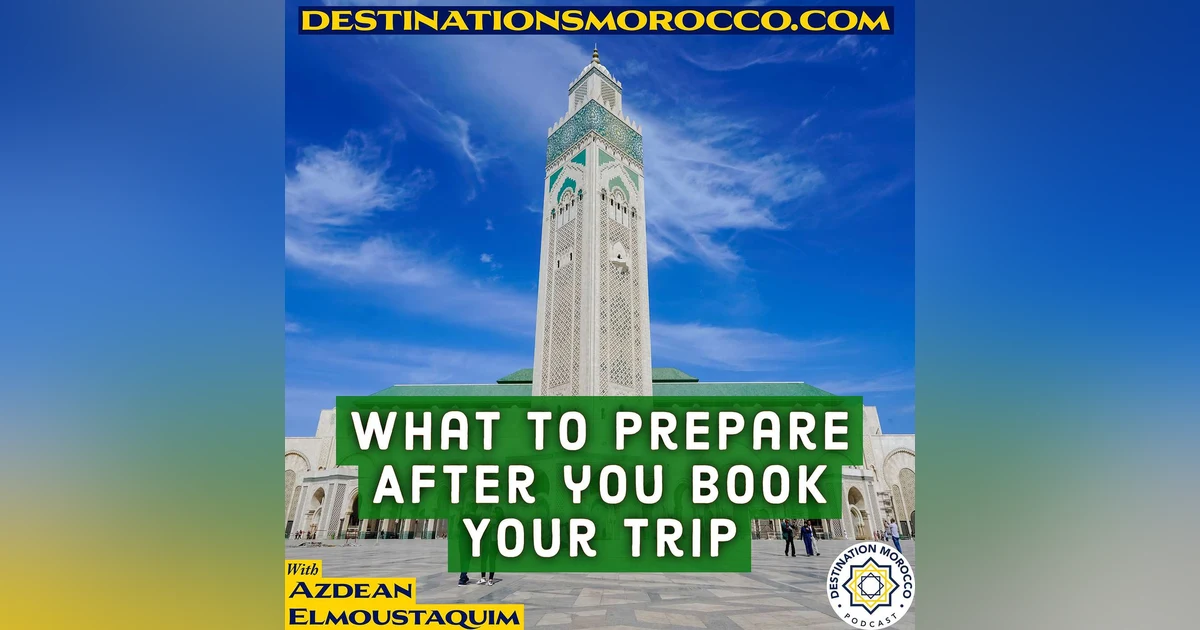

You've done the research, asked around, made some calls and booked the trip. It's happening! You're going to Morocco! Okay - what happens next? Today our focus is on the steps to complete after you've reserved the trip, and can shift into preparation mode. What to expect, what to plan, who to talk to and important things to prepare. Azdean and podcast producer Ted cover topics such as travel documentation, safety measures, special accommodation considerations like access and mobility, health ...
You've done the research, asked around, made some calls and booked the trip. It's happening! You're going to Morocco!
Okay - what happens next?
Today our focus is on the steps to complete after you've reserved the trip, and can shift into preparation mode. What to expect, what to plan, who to talk to and important things to prepare.
Azdean and podcast producer Ted cover topics such as travel documentation, safety measures, special accommodation considerations like access and mobility, health and medication, understanding tour inclusions, dietary restrictions, insurance essentials, and how to make changes to bookings.
We want to emphasize the importance of thorough preparation to ensure a smooth and enjoyable travel experience, especially when it's still a few months out from your trip (having booked well ahead of time, of course!) Don't be caught out by last-minute tasks that could have become more expensive, or worse, may no longer be possible.
Booking the trip is the main thing, but like any substantial vacation, there are particular tasks related to that destination. The good news is that Morocco is modern, accessible and accommodating, with a fast-growing tourism industry. This means that a lot of the regular concerns and requirements of travellers are becoming much more familiar.
But Destination Morocco is your best partner to ensure everything goes smoothly, that you have support before and during your trip, and that you can focus on enjoying this amazing experience. Whether an independent traveller or a travel agent, we're here to guide you from purchase to departure and beyond!
You can also watch the video version of this episode on our YouTube channel here:
"What to Prepare After you Book Your Trip"
Join me for an 8-Day Boutique Moroccan Experience!
https://trips.destinationsmorocco.com/Morocco-2026
Step inside the hidden Morocco on this first-of-its-kind, 12-spot journey, hosted personally by Azdean.
November 8-15, 2026, $1995 USD Per Person
Book Your Spot Today!
Learn more about Azdean and Destination Morocco.
AZDEAN ELMOUSTAQUIM: [00:00:00] Welcome back to another incredible episode of Destination Morocco Podcast. and this episode we also have Ted, the producer. Welcome back, Ted. again, it's always, a pleasure. It's always a lot of fun to have you, join me in, in these episodes. So it's, really, really fun for me to, to talk to you and, uh, to chat and, give the audience, I mean, oh, definitely, yes.
And give the audience some incredible advice, uh, really good, helpful content. So, uh, what do you have in stores for us today, please, Ted?
TED CRAGG: while we were thinking of something a little different at a different angle, we always talk about, you know, kind of why you should go to Morocco and things to see and do and as in the research and the planning of a trip. Well, what happens after you've booked? You've made the decision, you're going, that's awesome.
We can't wait to see you there. But what happens next, you know, uh, once you've booked the trip. So there's various steps and things to prepare, and [00:01:00] some of the timing I think involve with that as well. So, you know, particularly for travel agents who have their customers, their clients, right? And what's the role of the agents involved?
So really it's just, uh, yeah, kind of not skipping over that step, but really be conscious of what happens after you've booked your trip, because there's still a few things to, to, uh, sort out, I guess. So yeah, I mean, maybe it starts with, um, you know, making sure you have the right travel documents and visas if they're required.
We should talk about that.
AZDEAN ELMOUSTAQUIM: Absolutely. a lot of countries, uh, you know, like the US, Canada, you don't really need a visa to travel to Morocco. Uh, you're good with just your passport for 90 days, three months, you're good.
TED CRAGG: Yeah.
AZDEAN ELMOUSTAQUIM: So that gives you plenty of time to, to, to go do your vacation and come back. and also I highly recommend registering, uh, it's, it's called the STEP.
Let me see if I can find it.
Yeah. It's a smart travel program. Yes, it is really, really important for you to register, it's, uh, [00:02:00] the US Department of State. Uh, the program is called Smart Travel Program Step. Um, this really gives the, the embassy, your exact location.
They know exactly where you're at all the time. So just in case if something were to happen while you're traveling to Morocco or actually traveling anywhere else, uh, it's really, really important. Uh, that domain name, uh, again, it's, uh, mytravel.state.gov. Um, it takes you a few minutes to register and it's really, really, really helpful.
And like that said, there's no need for any vaccination to travel tomorrow at the moment. Um, yeah, so just don't forget to do it. Really
TED CRAGG: for something like a step, is that something the individual traveler has to do or can their travel agent do that for them?
AZDEAN ELMOUSTAQUIM: They actually have to do it themselves. So yeah, and when you travel, this is the benefit again, when you're traveling with a travel agent, they have done this, they, in different locations globally so they know exactly, uh, the steps to take for you, uh, you know, to, to do before [00:03:00] you, your actually, uh, trip takes place.
TED CRAGG: Okay. So they'll show people where to go. The per - the client has to actually fill in the details, but yeah.
AZDEAN ELMOUSTAQUIM: If, if you're from Canada, I'm, I'm sure that the website is gonna be different,
TED CRAGG: Yeah, we have a similar thing.
AZDEAN ELMOUSTAQUIM: Exactly,
TED CRAGG: Yep. Yeah, I remember we did that when we went, uh, three years ago and just, you know, just to make sure that they know you're there because something happens, then they know who you're there looking for.
AZDEAN ELMOUSTAQUIM: Absolutely.
TED CRAGG: yeah, so and then other prep involves, um, well, a- again, especially for the travel agent, they're gonna want to know if any of their clients have, uh, dietary issues or mobility issues and things like that to prepare for.
AZDEAN ELMOUSTAQUIM: Yes, that's really, really important. And the reason why, Ted, because we've talked about this again in, in the past, you see the reals and, and we do recommend them all the time, especially when you have a small group, of travelers or you have a family of two, four, maybe six, traveling. We want them to have their experience, but a lot of those reyads, some of them are not really accessible [00:04:00] by cars, so there's a little bit of walking in, involved.
It can be five minutes, it can be 15, 20 minutes and also some of them may have stairs. You have to climb upstairs from the normal, you know, street, few stairs, then maybe a few more stairs, then you get to the riad, and the riad itself has stairs and some of those stairs are really not like, you know, small, but they are big.
So, uh, it's very important, uh, if you have guests that they have mobility issues or knee issues, make sure that the riad doesn't have those steps or also make sure, "Hey, can they stay at the, at the first level?" Now, this is really important and again, this is a, a cultural difference or miscommunication sometimes because to us first level is ground level, you see what I'm saying?
So when you say first level to Morocco, that's the second floor.
TED CRAGG: Right.
AZDEAN ELMOUSTAQUIM: So just make sure you, you, you, you emphasize ground level, uh, because I know they, some of them, a lot of them actually, they do have rooms, available on ground level because if you say the first level automatically in [00:05:00] Morocco area is considered to be the second level.
TED CRAGG: Yeah, yeah. That's good to remember. yeah, so we talked about this a bit before, but what is the alternative then if, you know, if you have someone with the mobility issues and, and they just aren't comfortable staying in a place with so many stairs, like they could stay at a hotel, could they still go and visit a riad just to at least see what it's like?
AZDEAN ELMOUSTAQUIM: course. Not all, not all the riad have stairs, by the way. It just some of them just make sure, you know, if you're going through with us, we, we know where to put you, um, because we've been there, we've been working with those guys for some time. So we know the ones will say, "Hey, this is a good fit for this type of travelers, this is not a good fit for this type of travelers."
and we'll do that for you. Uh, but if you're going through your travel agent or traveling by yourself, you really need to ask and make sure, "Hey, do they have any stairs? Are they easy, accessible by car?" Now, let's, we talk about the Medina, we talk about Fes, the Medina and, and Marrakech, the square, in the square Jemaa el-Fnaa[00:06:00] square, there are about 700 probably more now accommodations, uh, in terms of royals and hotels.
So in that area many times they, it's not accessible by car. So your, your, driver or your car or company or tour company, whatever, they'll drop you off somewhere and then you still have to walk with your luggage to that riad. So just ask those questions because again, it's really, really important.
Now a lot of the riads, they have porters. So they will dispatch a porter to you and they will meet you at that specific spot and the porter will help you with the luggage problem solved. So the same thing, for example, when we talked last time about hot air balloons, you know, sometimes that's where the car is gonna meet you because the driver who's coming to pick you up, they are not gonna leave the car unintended and walk all the way to your yard.
For example, if it's somewhere hidden, because the car may get, you know, something vandalized or, you know, something and go and get you... No, they, the, the driver will stay with the car [00:07:00] then the riad will have somebody walk with you all the way to the car. So it just, those details when you're looking to, making those reservations that are really, really, really important.
TED CRAGG: Yep. Yeah, for sure. Uh, well, here's the question then. So if people need, you know, a specific type of accommodation, uh, in their tour package it'll say, you know, you're staying in Marrakesh out of riad. But do you need to sort out the exact riad and all that before the booking or do you book the tour and then short, sort out the specific
AZDEAN ELMOUSTAQUIM: a good question. Okay. I'll, I'll take you back to the process when we build the itinerary. When we build the itinerary, when we do it, whether it's a B2C or a B2B with advisors, it takes a little bit of back and forth. We, we present them with the first draft, 99% of the time we, we need to make changes and adjustment after the agent represents it to their guests.
So they'll say, "Hey, you know, I like this, I like this, I need to change this, this experience I don't really care for. I wanna do this experience instead." So we, we go back and forth. [00:08:00] So the process of really approving the item that we can vary between two weeks, two, three or four weeks, making all the changes, taking in consideration, not everybody's, is, is available at all, all times.
So when we do that, we say, "Hey, in Marrakesh, this is the riad that we have selected, and we'll give them a name, for example. Um, and you know, in first, this is the reality we selected and, and so forth and so forth. And then we say or similar, uh, in terms of accommodation. So by the time the client makes a decision because sometimes we go through three or four revisions of the itinerary and, you know, two months later we still haven't finalized the itinerary.
By then, that read that we initially selected for them is already booked. So now when, when that happens, we just inform them, say," Hey, you know, the realtor we initially talked about in Marrakesh is actually booked now because it, we cannot, I mean, we cannot really hold an accommodation. We can say, Hey, this is good for two weeks.
Um, we cannot hold the room for a long, [00:09:00] long time. and then when, when the, the, the itinerary is finalized, then it becomes a proposal. So when the guest or the agent pay, uh, or put a deposit for their clients, that's when the booking is actually confirmed. So when it's just, you know, two people, four people, six are traveling, it's different.
The deposit is less, but then when you have a group, a lot of those accommodations, you could be booking the whole yard for a small group because the, uh, the, you know, the, the, there's not too many rooms. So they want, you know, everything paid, uh, that way they, they, they're guaranteed and they cannot hold something for you and they have somebody else come in and it's just gona create a conflict.
So booking the, the tools, it's, you know, it's a little bit different. Sometimes can be challenging when it's a busy time or last minute thing. So just give your some time to book ahead of time, and do it the right way so...
TED CRAGG: So the point is that you need to make the decisions on the exact riad you wanna stay, again, if there's mobility issues or [00:10:00] other things, location, when you ultimately book and pay at least the deposit.
AZDEAN ELMOUSTAQUIM: Yes, 100%, yes.
TED CRAGG: Yeah. Okay, good. Well, that's good to know. all right. Well, tell us on our list here. We, uh, uh, in terms of preparation, there's, well, medical issues, health issues, medication, um, knowing what you need and also what you can get there in Morocco.
So it depends on the person, but I mean, you know, maybe your standard kind of medication, how accessible, how easy is it to kind of walk into a pharmacy and get something you need
AZDEAN ELMOUSTAQUIM: Uh, the The pharmacy in Morocco is, it's really different than the US, for example. Ted, it's a really good question, by the way. Uh,
TED CRAGG: I knew you'd
say it was different.
AZDEAN ELMOUSTAQUIM: Yeah, yeah, I know. Because you can get a lot of medication or a lot of medicine that here in the US, you have to have a doctor give you, you know, uh, a prescription for it.
In Morocco, you don't, like antibiotics. You can just walk into the pharmacy and say, "Hey, I need this, this, or whatever and they'll give it to you. " Now, so medication, of course, is different when we're talking, [00:11:00] like the incident that we had with the heart condition with one of our guests, um, she had to, she, we had to take her to the ER and she spent the night in, the, uh, the, the ER, but the doctor was able to give her the same medication that she was taking, and then she was good, but you're probably going to need a doctor's, you know, note or something to get that type of, medication from the pharmacy.
But the pharmacy in Morocco is very flexible.
TED CRAGG: Okay.
AZDEAN ELMOUSTAQUIM: Yeah.
TED CRAGG: So, you know, and then beyond that, of course, it's up to the individual, but the travel agent can remind their clients too, you know, make sure that you have, you know, the the, uh, medication you need and they should give a, they should give a list or the information to their agent as well, right?
So they
know
AZDEAN ELMOUSTAQUIM: Yes I totally agree just in case, because it's really, really important, yeah.
TED CRAGG: Mm-hmm. Okay. So that's an important thing.
we could talk a bit about essentially what's, what's included and what's not included in a tour and so, people know what to maybe pack for and what to plan, what to budget [00:12:00] for and, uh, you know, as part of their planning after they book the trip, but they know also what to kind of, you know, prepare for as a result.
AZDEAN ELMOUSTAQUIM: Oh, sure, sure. You know, it's, again, when we build the itinerary, we send it to the agent and there's a part where it says what's included in the tour and what's not included. Now, we do the same thing for the B2C. A lot of people, they don't really pay attention to this pot and, uh, I'll be very honest.
The reason because they're not really focused on it at that moment, they're focusing on the price, they're focusing on the tour, they, they want to get this done and so forth. So that part really gets ignored most of the time. and again, um, this is one of the things that we do before they travel to Morocco is we go over all the details of the itinerary.
We make sure, okay, let's look at what's included. The current driver are with you literally twenty four seven. That's your constant. If you're going on a group, uh, the constant will also be your national tour guide or tour leader. if [00:13:00] it's a, a, a group of two, I mean, two people, four people, six people traveling, then the, the current driver is still the constant.
Then you'll have the local guides. Then, um, you know, breakfast is included in all accommodations. Again, when we doing, for example, where is this at? We're doing Imlil, when we're doing for example, doing Midelt, for example, Dades Valley, we're doing, Zagura, anything in the southern part of Morocco or Merzouga, Erfoud, dinner if we spend the night, dinner is included.
Breakfast is also included.
TED CRAGG: very remote,
AZDEAN ELMOUSTAQUIM: Yes. Then you have the entrance fees. For example, you're gonna visit, um, you know, Majorelle Gardens in Marakesh. Then you, we're not gonna, you know, everything is done online, so you're not gonna wait, you know, at that time, you know, you waiting online to get your ticket or buy it, you ha - it has to be done before.
For example, the same thing doing, you know, Volubilis, we take care of that for you. So anything that we know that you have to pay for in advance, we take care for you, in advance. So, uh, that way you're just [00:14:00] saving on time and, and really immersing
TED CRAGG: Yeah, that makes a big difference. Yeah. Okay, yeah. Well, that's good to know. Um,
AZDEAN ELMOUSTAQUIM: I wanted to add the, uh, Hassan II mosque visit. It's included, uh, I, I think per person it's about, I would say because of the, uh, dollar US, US dollar exchange, almost between 15 to $20 depending on the exchange. In the past, they have a museum, uh, just in case a lot of people don't know.
They have a museum, it's a beautiful, beautiful museum. Y- you know, it shows everything about the mask from the time it was starting to be built until the moment they finished and also now they're expanding few things, outside the mosque and you can see them, there's a little bit of construction. So the entrance, used to be to, inside the mosque, 15 or $20 then to the museum, 15 or, or $20.
Now they have on entrance for both and it's still the same price. So yes, yes. So if you just gonna go and, and, and watch the [00:15:00] mask from outside, there's, you don't pay anything, but if you're gona go inside and do the museum, then, uh, you know, the ticket for the museum gives you also, access to inside the mosque, just keep that in mind, yeah.
TED CRAGG: And I mean, obviously on tours and stuff, this would be the case anyway, but with the mosque, are they only, can you only go in as a tourist as part of a guided tour?
AZDEAN ELMOUSTAQUIM: That's a good question. Well, I've only been there with customers.
TED CRAGG: Yeah.
AZDEAN ELMOUSTAQUIM: So, well, yes, bec - I, think if you buy the ticket, you can go.
TED CRAGG: Okay.
AZDEAN ELMOUSTAQUIM: yeah, you just need to buy the ticket because it's open to everybody. Now, there are, they have the first visit I think, um, now the time changes depending if it's summertime, if it's Ramadan, if it's, uh, winter time, it's normally around 9:30, 10 o'clock, 10:30 and stuff like that.
but you get your ticket, you go in and, and nobody really bothers you. They give you a little, you know, plastic bag where you can put your, your shoes and go inside. [00:16:00] I highly recommend the local guide though, and you can hire somebody on the spot. It's not an issue, you'll see them there, you, you hire them, um, and you're
good to
go
TED CRAGG: I guess then in, in other words, it's like if you, I, I mean, this is kind of more if you're traveling on your own, but if you, if you did show up at the mosque and maybe it's a timing issue, but you just wanted to go in and wander around on your own, is that allowed? Or do you have to be part of a guided tour?
AZDEAN ELMOUSTAQUIM: you don't have to be a part of the, uh, the guided tour. Just buy the ticket and you go inside, yes. You can just go by yourself. Yeah.
TED CRAGG: Yeah. Okay. I was curious about that. Well, I was a bit off topic, but it's good to know, yeah.
AZDEAN ELMOUSTAQUIM: if you're a local and, and you wanna go in, just, just wait until the prayer time, you'll go for free. Uh, and yeah, you can just wander around for a little bit, so yeah.
TED CRAGG: Yeah. Mm-hmm. And of course, it's very well worth visiting. It's a stunning
structure,
AZDEAN ELMOUSTAQUIM: Ah,
TED CRAGG: yes. It's one of the highlights for sure. Um, okay, let's talk about the big topic which is insurance. So, I mean, I think again, in, especially in the frame of [00:17:00] like a travel agent, I mean, agencies usually have their partners and they can kind of guide people, but is there anything that the travel agent particularly needs to know about Morocco or information they need to get from you to then help with their clients who have booked a tour and now they need insurance?
AZDEAN ELMOUSTAQUIM: think when it comes to, to insurance and, and travel advisors, um, most of the ones that I've talked to, they're very equipped. they know exactly, uh, the company, to book or to choose for their guests. Uh, there are a few different choices, obviously, but, Morocco is a little different, um, uh, a little bit when it comes to this.
There's, uh, I talk about it all the time. There's, uh, Allianz, uh, some time ago, they have an office everywhere else, uh, and I know they have, uh, local offices in, in Morocco. and I've seen them during the pandemic. I've seen what they have done for the travel industry for the travel advisors and it's just really, really incredible.
Uh, the second one that I can think of is Chubb, uh, Travel Guard, I think, Travel Safe, something like that. [00:18:00] and there are a few, companies that are really, really, uh, important, to get to know, to get to work with. Uh, the, the travel advisors, they know them, better than I do actually.
Uh, when it comes to the B2C, I, I, I do make some recommendations, but you know, always ask, your travel advisor, uh, you know, cancel for any reason, and look at insurance A versus insurance B versus insurance three. Um, you know, the basic plan, how much is it, you know, out of pocket, what's the coverage?
Is it a million? Is it two million? Then some, what's the premium package? Sometimes you just need a basic, package. It, it has enough coverage. And again, it, it depends on, you know, the state, um, date of birth, the cost of tour. So, and again, your, your advisor, they know exactly what to, to ask and they'll have that information already.
if you have been traveling with them for a while, they have literally all the information they need that they can get you a quote, really, really quick. So those are the things if you're doing this on your own, just by yourself, travel [00:19:00] insurance is, it's, it's really, really important, uh, it's, it is an investment and it's worth every penny.
It'll cost you maybe, uh, $100, couple hundred dollars, uh, person, but it's, it's definitely worth it. I highly recommend it, yes.
TED CRAGG: And that relates to the next question, which is about, well, what if people need to make changes after they've booked? So, you know, maybe they wanna add a person, maybe someone can't go and they need to remove a person, maybe they, for whatever reason, they wanna add a couple extra days or they have to come home early, you know?
Any of those kind of fairly substantial changes, I mean, how doable is that and for the travel agent, like, what steps do they need to take?
AZDEAN ELMOUSTAQUIM: Uh, for the most part, they are really doable, especially if, we have time to, to, to make those changes, this happens quite a bit with the group tools because you don't really know, um, how many people are gonna be traveling with you. So let's say, for example, we are in 2026, some people are already working on, [00:20:00] 2027, April, uh, maybe September, October, November tools.
So they'll say, "Hey, you know what? I have 10 people booked, and then between now and then, many things can happen. And this happened in the past, you know, this travel A is not, traveler A is not going anymore for whatever reason, now we're gonna find somebody else that replace them, even though they put the deposit or they paid.
So those things will work out with, with, with the travel advisor, but in most cases, we were able to always make those changes.
TED CRAGG: yeah, so, I mean, is there a bit of, is there a deadline maybe for when, you know, people can make changes? How last minute can that happen?
AZDEAN ELMOUSTAQUIM: I mean, for groups, I would say last minute is probably three or four months, you know, because we, uh, again, we don't wanna have the issues not available or the availability, especially, you know, having one traveler being put somewhere else different than the rest of the group. [00:21:00] So, um, yeah. And also because of the group, we have a little bit of restrictions in terms of the accommodations.
If we're doing the yard, it's a little bit restricted in terms of availability versus you have a hotel. So if it's a hotel, it's still decent. Uh, it can be challenging if it's a, you know, high season, but in most cases, it's, it's doable. So, we've seen it in the past, you'll have, sometimes Marrakesh is really busy, let's say for example, in October, because they have some mice events, they have some tournaments, they have some things happening in the city and that can be, that can be challenging for us.
So that's why it's really important for the groups, you know, three months may seem like it's a long time, but it's really not a long time. So we just have to be informed right away, uh, for making those changes.
TED CRAGG: Mm-hmm. Okay. Well, that's good to know. Um, I wanna circle back to dietary issues. We, uh, touched briefly on that, but I think a little more detail. So if someone has, uh, food allergies or, you know, other [00:22:00] dietary issues and they tell their travel agent, what does the travel agent need to tell you? Like, do you need to inform every single, I guess every single restaurant, but how kind of organized and structured does that need to be?
AZDEAN ELMOUSTAQUIM: That's, that's a really good question, Ted. Uh, we did the best that we can to accommodate, all the dietary restrictions, but sometimes even us are limited, in a way, depending where we travel. So for example, we are limited in many, in many different ways, uh, when we go to the southern part of Morocco. So I'll give you an example. You have somebody that just want to have fish all the time. Um, you know, anywhere you go, you have it fresh, even, you know, Marakesh and, uh, whatever city, even fest even though, there's no ocean, but they have fresh seafood every day. Uh, then when you go to the southern part of Morocco, it just, it's, it's just not available in terms of the freshness, in terms of the way, and, and all that stuff.
So that can be very, very challenging. So if it's something, you know, like, [00:23:00] hey, you know, I'm vegetarian, that, that's, that's not an issue. Some of the ti - dietary, um, you know, restrictions are okay, but when it comes to certain ones that it's really details, you know, we can have limits in terms of accommodating the guests.
So especially again in the south of Mocco versus the north of Morocco.
TED CRAGG: Can you bring, as a tour operator, can you bring food with you to some of the remote places, you know? Is that kind of feasible,
AZDEAN ELMOUSTAQUIM: We can do
TED CRAGG: or something?
AZDEAN ELMOUSTAQUIM: you know, I talk about, and I say this many times, uh, Morocco we don't have, uh, an ice culture, for example, you know, with the drinks, you, you, you go to a restaurant and say, "Hey, can I get a, a Coke with ice or iced tea or whatever?" And you get plenty of ice in Morocco, you say, "Hey, can I get a Coke with ice?"
They, they'll give you one or two ice in the Coke. So, um, they don't have that culture, but, you know, when we go on tours, I always make sure we have ice in the [00:24:00] coolers, and even when you have ice, for quite some time, you have to change it and we did this in, in the southern part of Morocco where we did not have ice actually, but there's a guy, at a small city right before going to the desert, he puts, uh, bottles of water, big, you know, two little bottles of water in the, in the freezer, uh, for a couple of days for us.
So when we, when we get there, it's, frozen. So it, it lasts you a couple of days, but beyond that, you definitely need to find fresh ice somewhere and you can do it that way, not an issue at all, but generally it's, it's gonna be difficult.
TED CRAGG: Well, because I'm thinking if, if someone, you know, is on a tour and they have certain food they need to bring and I, I mean, it has to be reasonable, something that's fairly small, I guess, obviously easy to travel with, but if they need a cooler, if they need a place to store that food or, or liquid, you know, uh, keep it cool, is that possible?
AZDEAN ELMOUSTAQUIM: absolutely. Yeah, we, the, we, we always [00:25:00] have a cooler inside the vehicle, whether it's, uh, you know, uh, six passengers, 17 passengers and a mini bus, you always have a cooler. Yes, yeah, that's not an issue at all. Yeah, the cooler is always with the van so, because that's what the water comes with the van anyways, yeah.
TED CRAGG: Yeah, yeah. Hmm. All right. And well, I'm just, I guess that the, the guests are welcome to use that if they
AZDEAN ELMOUSTAQUIM: Oh, 100%, yes. Uh, even if we need to get, get an additional cooler, uh, yes, we can definitely do You know, nowadays they have the ones that you can actually plug into the car and it stays, cool. So it just the frozen parts, you know, the ice and stuff, but it can be managed, so.
TED CRAGG: Mm-hmm. Okay. well, I think that pretty much covers it. We talked about, uh, yeah, immunizations and visas, which are, uh, rarely, it depends where you're from, but, you know, most of the United States, Canada, most Europe, I'm sure they don't require visas. But one thing that's important to my people is, uh, your passport expiration date.
Is there anything specific to Morocco [00:26:00] that they look for
AZDEAN ELMOUSTAQUIM: Well, you know, uh, during the pandemic, this was really, really, um, a big issue, especially with the US, uh, services locations have been, you know, closed and, and the passport something that you really have to do in person. what I recommend it, you know, normally they say, "Have your passport available six months after you come back to your home, uh, from vacation, whether it's Morocco or somewhere else."
I would say make it a nine months, just to be on a safe side because, during the pandemic that was a big issue and, and a lot of people got stranded in, in different countries and their passport got, you know, expired and stuff like that. So just have it a, a nine months, it's, it's a good window, especially here in the US, they give you, your passport is bad for 10 years.
In other countries, I think in Morocco they, they, they give us five years, um, I, I think that's gonna change, uh, maybe next couple of years or so.
TED CRAGG: that's useful. We, they changed that here in Canada, uh, not too long ago where we can get 10 year passports, [00:27:00] which is nice. You don't worry about it as much.
AZDEAN ELMOUSTAQUIM: Yes, that's true.
TED CRAGG: Yeah. Okay. Well, anything else come to mind for you, but in terms of prep and, uh, getting ready for a trip again after you've booked?
AZDEAN ELMOUSTAQUIM: Yes. Um, after you book now, now, again, it just, it depends, uh, who's traveling. If it's two, four, six people, a group of 12 or so, I always recommend, getting in touch. Uh, we need to meet at least two to three weeks prior to you taking the trip Uh, to Morocco, again, because there are last many things that probably gonna think about your guests are gonna think about that they have not thought of, um, you know, during the whole process.
Um, and then we tell them exactly what to expect and, and how to expect. Even though we talked about it in the past, most likely they're gonna forget it so it's fresh in their mind. And then, you know, uh, a day or so before they're, they're traveling, we send the, the, the travel advisor the name of, uh, the driver then we ask them if they wanna give our, you know, [00:28:00] information to, to the traveler's families, uh, and they need to get in touch with us and stuff.
and if somebody needs a SIM card, we give them a SIM card, in Morocco. Most of the time they, they just wanna have like internet access and, you know, little bit of data and, and, and to make phone calls and have, uh, internet access. Uh, the vehicles are equipped with wifi devices. So it's, uh, yeah.
And then if it's, if you book and it's, there's a six months window, I would say every couple of months is a good time to meet, uh, again, just to touch base, just to make sure everything is still the same and everything is good and so forth, yeah. But I, I definitely recommend meeting, a minimum of two times to three times before your trip, especially it's, you know, four months, six months, uh, ahead of time.
TED CRAGG: That's good. Yeah, I like that because, you know, often you book a trip and it's six or eight months or more away and like you do all the planning, the research, you book it, you pay at least a deposit if not more and then you kind of forget about it for like eight months. [00:29:00] And it's nice that you guys keep in touch and there's a bit more of that steady communication, right, and context.
So it, it just makes the whole thing feel that much more real I think and not something off in the distance and did we actually book that thing? Yes. Like it's happening and it feels more living alive, right? And, and real. So that's, that's a nice touch.
AZDEAN ELMOUSTAQUIM: Absolutely. I totally agree. That agree, yeah.
TED CRAGG: Alrighty. Well, I think that covers, uh, certainly the most important things.
There's always, I guesspose little tiny details and a pack, we can do an episode on like a packing list actually. That's a
AZDEAN ELMOUSTAQUIM: Yes, we haven't done one in a while. Yes. Uh, that's gonna be really, yeah, very good
TED CRAGG: But, uh, yeah, again, it's, uh, the theme of this one here was, after you've booked, so we always talk about, you know, one of the reasons why you should go and all the excited things, which is great, but yeah, and then what happens to the people they've booked?
Like we haven't forgotten about you either. Like it's exciting. So what's, uh, what are the next steps? And it's been good to cover some of that here too.
AZDEAN ELMOUSTAQUIM: Perfect. Thank you much. Thank you,
TED CRAGG: Good. [00:30:00] Well, I'll see you, uh, see you next time.
AZDEAN ELMOUSTAQUIM: Absolutely. Thank you, thank you. Have an amazing day. Thank Bye-bye.